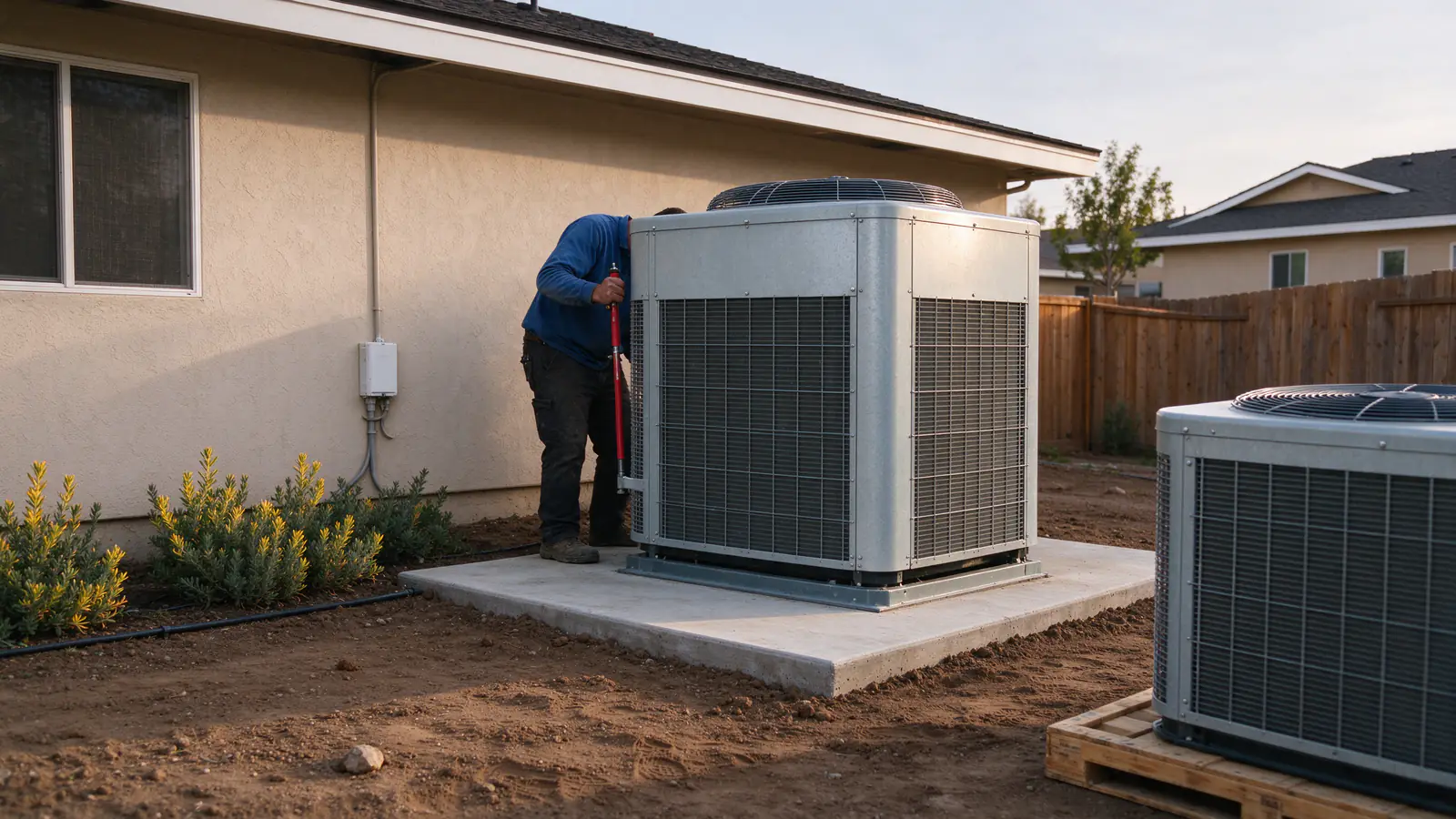
What does a heat pump actually do?
A heat pump is a central air conditioner that runs in both directions. In summer it pulls heat out of your house and dumps it outside, like the AC you have now. In winter it reverses and brings outdoor heat inside.
A reversing valve flips the refrigerant flow, so one outdoor unit, one air handler, one set of lines and one thermostat do both jobs, with no burner or flue to service. When Veranda Bakersfield Heat Pumps handles a heat pump installation, we plan that one system for both seasons.
What parts make up a ducted system?
| Part | Where it sits | What it does |
|---|---|---|
| Outdoor unit | Side yard or back yard, on a pad | Compressor, outdoor coil, fan and reversing valve |
| Indoor air handler or coil | Hall closet, garage or attic | Blower moves air across the indoor coil and through your ducts |
| Refrigerant lines | Between the two units | Carry refrigerant in and out of the house |
| Auxiliary heat strips | Inside the air handler | Back-up electric heat for cold mornings and defrost |
| Thermostat | Hallway wall | Tells the system when to heat, cool and bring on back-up heat |
| Condensate drain | From the indoor coil | Carries cooling-season water out of the house |
Why does a heat pump suit a Bakersfield house?
Bakersfield is a cooling town with a short, mild heating season. Summer afternoons run over 100 degrees, and winter is mostly cool days and cold valley mornings, sometimes with tule fog, rarely the long freezes that make heat pumps work hard.
That climate plays to a heat pump’s strengths. It cools the same way a good AC does, and its winter heating is the easy kind: modest lifts on mild days. For a single-story ranch house with ducts already in the attic, the move is mostly a cooling replacement that also takes over the heating.
What a heat pump cannot fix
What a heat pump cannot do is make up for a bad install. A system sized by guesswork, pushing air through crushed attic ducts, with the outdoor unit baking against a west wall, will struggle in July whatever the label says. Our guide to heat pumps in Bakersfield summer heat covers that in detail.
Which system choice fits your house?
Most houses start from one of three places.
- You already have a heat pump. This is a like-for-like replacement. We size the new one fresh rather than copying the old label, and check the ducts and electrical while we are there. See heat pump replacement.
- You have a gas furnace and central AC. This is a conversion. The furnace comes out, an air handler goes in, the gas line to the furnace is capped, and the house usually needs a new 240-volt circuit. See furnace to heat pump conversion.
- You have a working furnace you want to keep. A dual-fuel system pairs a heat pump with a gas furnace that takes over on the coldest mornings. Our dual-fuel guide explains when it fits.
Single-stage, two-stage or variable-speed?
A single-stage heat pump runs flat out or not at all. A two-stage unit has a lower setting for mild days. A variable-speed unit ramps up and down across a wide range, which tends to mean longer, quieter runs and steadier room temperatures.
Which one makes sense depends on your ducts, your budget and how you use the house. Our page on variable-speed heat pumps explains the trade-offs without promising savings that depend on your house and habits.
How do we size a heat pump for your house?
We size from a load calculation, using an industry method such as ACCA Manual J, built from your actual house: floor area, ceiling heights, windows and their direction, insulation, the attic and the ducts. Size does the most damage when it is wrong.
Square footage alone cannot do this. Two 1,700 square foot houses on the same street can need different sizes if one faces west with big windows and thin attic insulation. The old unit’s label is not proof either, because it may have been sized by rule of thumb decades ago.
What the wrong size does
- Oversized: it cools the air fast, shuts off, and starts again a few minutes later. Rooms swing, the system wears faster, and it removes less moisture.
- Undersized: it runs all afternoon in July and still falls behind.
Our sizing guide walks through how the calculation works.
Will your ducts carry the air?
A heat pump moves a set amount of air across its coils to work properly. If the ducts cannot carry that air, the system loses capacity no matter how good it is.
In Bakersfield the ducts usually run through an attic that gets far hotter than the outdoor air on a summer afternoon. A crushed flex run, a disconnected joint or a leaky plenum in that attic loses cooling before it reaches the room, and a single undersized return can starve the whole system.
What we check on the duct side
- Static pressure, which tells us how hard the blower is working against the duct system.
- Return air: how many returns, how big, and whether the hallway grille is choking the system.
- Supply runs to the rooms that are always hot, often the west bedrooms.
- Visible leaks, crushed or kinked flex, and sagging runs in the attic.
- Duct insulation where we can see it.
When we find a problem, it goes in the estimate as its own line, so you can see what it costs and why. The guide to ductwork and airflow goes deeper.
Does your electrical panel have room?
A heat pump needs a dedicated 240-volt circuit for the outdoor unit, usually another for the air handler and its heat strips, and a disconnect at the outdoor unit. A replacement may reuse existing circuits; a conversion from gas heat often needs a new one.
We open the panel during the site visit and check the service size, the space for new breakers and the condition of what is there. If the panel has room, the new circuit goes in the estimate. If it is full or too small, we tell you before you decide anything. The page on electrical requirements covers the details.
Where does the outdoor unit go?
The outdoor unit goes on a level, stable pad with the manufacturer’s clearances on every side, room to service it and open airflow. Bakersfield side yards are tight, and the spot the old condenser sat in is not always a good one.
What we keep the unit away from
- A west-facing wall in full afternoon sun, where the unit breathes hotter air than the rest of the yard.
- A dryer vent that blows lint into the coil.
- Boxed-in corners, where dust from the valley and nearby fields loads the coil faster.
- Walkways, where winter defrost water would drain and puddle.
- A bedroom window or a neighbor’s patio, where sound carries.
We also plan a sensible path for the refrigerant lines. Our page on placement, sound and condensate has more.
Do the indoor and outdoor units have to match?
Yes. A heat pump is designed and rated as a matched system: a specific outdoor unit with a specific indoor coil or air handler. Pairing a new outdoor unit with an old indoor coil can cost capacity and efficiency and upset the refrigerant charge.
Your written estimate lists the model numbers for both pieces, so you can see that they belong together. If you are keeping any existing indoor equipment, we say so and explain why it fits. The guide to matching indoor and outdoor equipment explains what a matched system means in practice.
What thermostat and controls does it need?
A heat pump thermostat has to know it is controlling a heat pump. It runs the reversing valve and decides when to call for the auxiliary heat strips. Set up wrong, it brings on the strips on mornings the heat pump could handle alone.
We check whether your current thermostat can run the new system and set it up for your equipment at startup. If it cannot, a compatible one goes in the estimate. The guide to auxiliary heat and thermostat controls explains how the back-up heat is meant to work.
Does a heat pump need a permit?
A heat pump installation needs a mechanical permit, and often an electrical one as well. Which office issues it depends on your address, not on the town you think of yourself as living in.
We check your address before the permit is filed, so it goes to the right office. The permit is a line in your written estimate, and the inspection follows the install. More on this in our guide to Bakersfield heat pump permits.
What does a heat pump installation cost?
Veranda’s typical range for a like-for-like ducted heat pump replacement is $6,500 to $15,500. Veranda’s typical range for a furnace-and-AC conversion is $8,000 to $15,500. Your price comes from the site visit and is set out in a written estimate.
What moves the price?
- The size the load calculation calls for.
- Single-stage, two-stage or variable-speed equipment.
- Duct repairs, a crushed run replaced or a return added.
- Electrical work: a new circuit, a disconnect, or panel limits.
- Where the air handler sits, and how hard the attic or closet is to work in.
- Outdoor unit placement and the length of the refrigerant line run.
- Thermostat changes and optional upgrades, which we price separately.
What did recent jobs cost?
| Job | House | Work | Budget | Time on site |
|---|---|---|---|---|
| Rosedale replacement | 1,700 sq ft single-story ranch | 3-ton ducted replacement, one crushed supply run to the west bedrooms replaced | $11,000 | 1 day |
| Oildale conversion | 1,300 sq ft 1950s house | Furnace and AC out, air handler in the hall closet, new 240-volt circuit, gas line capped | $12,400 | 2 days |
| Shafter replacement | 2,100 sq ft single-story | Same 4-ton size kept, second return added | $14,200 | 2 days |
The heat pump replacement cost guide breaks down each part of the price. You can also try the cost estimator before we visit.
Are there rebates?
Sometimes. Programs depend on your address, your utility, the equipment and whether a program still has funding. When we visit, we tell you what we know applies to your house. If a rebate fits, it shows on its own line in the estimate.
We never count a rebate in your price until it is approved. That way the number you sign is the number you pay, whether or not the rebate comes through. See heat pump incentives near Bakersfield.
What happens on installation day?
We arrive, walk the job with you, and protect floors along the path to the air handler. Then the work runs in a set order.
- Power off, old equipment recovered and removed, refrigerant handled properly.
- Pad set or checked, outdoor unit placed and leveled.
- Indoor air handler or coil set, condensate drain run and tested.
- Refrigerant lines run or flushed, connected, pressure-tested and evacuated.
- Duct repairs, returns and transitions completed.
- Electrical circuits, disconnect and thermostat wiring finished.
- Startup and checks, then a walk-through with you.
Removal and disposal of the old equipment is in the estimate, so nothing is left in your side yard.
How do you know it was installed right?
Startup is where a good install proves itself. We charge the system to the manufacturer’s specification, measure airflow and static pressure, check temperatures across the coils, test heating, cooling, defrost and auxiliary heat, and check the condensate drain.
You get the startup readings in writing. They become the baseline for every maintenance visit after. Our guide to startup and commissioning lists the checks.
What is it like to live with a heat pump?
A few things feel different from a furnace and AC.
- Warm air, not hot air. A heat pump delivers air that feels warm rather than blasting hot. It runs longer and evens out the house.
- Defrost on cold mornings. On a foggy winter morning the outdoor unit may pause, hiss and steam for a few minutes while it clears frost off its coil. That is normal.
- Steady settings work best. Big overnight setbacks can trigger the back-up heat strips in the morning. Small changes suit a heat pump better.
- Long summer runs are normal. On a 105-degree afternoon, a well-sized system may run for long stretches. That is the system doing its job, not failing.
How do you keep it running for years?
Twelve-plus Bakersfield summers wear a system down, and the dust that loads outdoor coils here makes regular care count.
- Filters. Check monthly in summer, change when dirty.
- Outdoor coil. Keep plants, lint and debris clear; we clean the coil at maintenance visits.
- Condensate drain. A clogged drain can back up into the closet or ceiling; we clear it at each visit.
- Twice-a-year visits. We check refrigerant pressures, airflow, electrical connections, defrost and heat strips, and give you a written note of what we checked and what we saw.
Nothing is replaced before we tell you the cost. Our heat pump maintenance service and the maintenance checklist cover what each visit includes.
Where do we install?
We install heat pumps across Bakersfield and in Oildale, Rosedale, Shafter, Lamont, Arvin and Wasco.
From the Panorama Drive bluffs to the houses off Highway 58, the work starts the same way: a site visit, a load calculation and a written estimate. Request an estimate and we will set up the visit.