How does a dual-fuel system work?
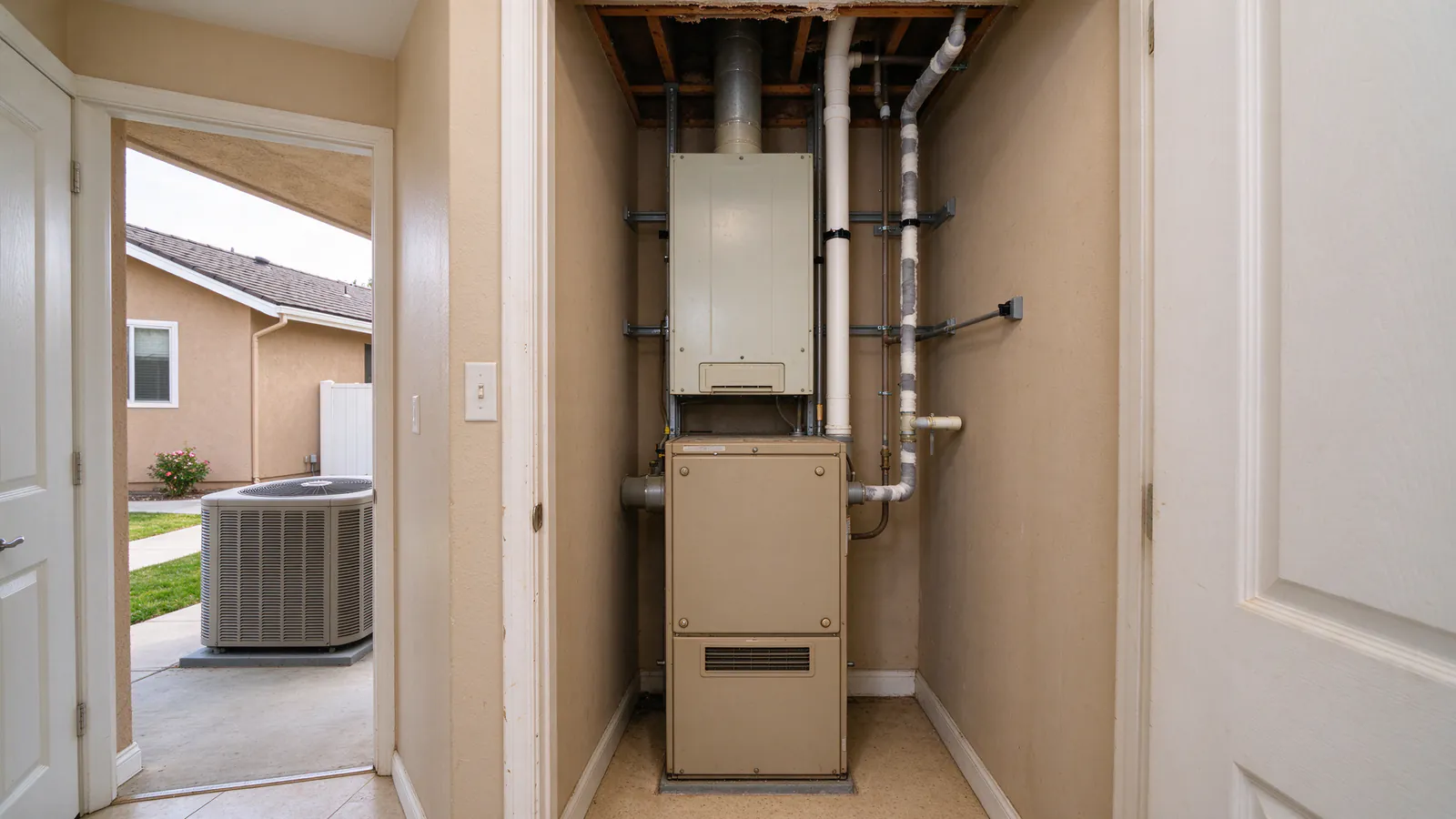
A dual-fuel system pairs a heat pump with a gas furnace. The heat pump sits where the AC condenser would, cooling the house in summer and moving heat indoors in winter, while the furnace stays in place as the backup.
The furnace keeps its burner, blower and flue but no longer does most of the heating; the controls bring it on only when conditions call for it. At Veranda Bakersfield Heat Pumps we set up that handoff as part of the install.
When does the furnace take over?
The switch happens at a balance point. That is the outdoor temperature where the heat pump alone can no longer keep up, or where gas heat becomes the cheaper way to warm the house.
There are two common ways to set it:
- Temperature switchover. Below a set outdoor temperature, the heat pump stops and the furnace runs. Above it, the heat pump runs.
- Cost-based switchover. Some thermostats take your electric and gas rates and pick whichever costs less to run at that outdoor temperature.
During defrost, a heat pump briefly reverses to melt frost off the outdoor coil. In a dual-fuel setup, the furnace usually covers that moment so you do not get a blast of cool air. Our guide to auxiliary heat and thermostat controls covers how backup heat is staged and locked out.
Does dual fuel make sense in Bakersfield?
Dual fuel was built for places with long, hard winters, where a heat pump struggles for weeks at a time. Bakersfield is the opposite. Winters are mild, cold valley mornings and tule fog are the low point, and most days warm up by midday.
That means a heat pump on its own can carry most or all of the heating in many valley houses. The furnace in a dual-fuel system might run only on the coldest mornings. Whether keeping it is worth the upkeep depends on your house, your utility rates and how you heat.
What a furnace that rarely runs still needs
A furnace that sits idle for most of the winter still needs a check before the cold mornings arrive. Dust on a burner or a weak igniter only shows up on the first cold morning the furnace is needed.
With dual fuel you look after two heating systems in one closet, even if the furnace works only a handful of mornings a year. The furnace side keeps:
- A live gas line.
- The burner, flame sensor and pilot or igniter.
- The flue, venting and draft.
- Condensate from a high-efficiency furnace.
Our heat pump vs central air and furnace guide compares the three setups side by side.
What decides whether dual fuel fits your house?
Ask us whether it fits your house. These are the things we look at during a heat pump installation visit before anyone talks about equipment:
| What we look at | Why it matters for dual fuel |
|---|---|
| The furnace’s age and condition | An old furnace near the end of its life is a poor base for a new heat pump |
| Furnace blower and indoor coil | The coil has to match the new outdoor unit, and the blower has to move the right airflow |
| Gas line, flue and venting | The furnace still burns gas, so these stay in service and need to be sound |
| Thermostat and controls | The control has to handle both heat sources and a switchover point |
| Electrical panel | The outdoor unit still needs its own circuit and disconnect |
| Ducts and return air | Both heat sources share the same ducts, so leaks and weak returns affect both |
The electrical requirements guide explains the circuit and panel checks in more detail.
How does dual fuel compare with going all-electric?
If you start with a furnace and AC, you have two paths. Here is how they differ in practice:
Keeping the furnace
- The gas furnace, gas line and flue stay in service.
- Backup heat comes from gas instead of electric strips.
- The electrical load can be lower than an all-electric system with large heat strips.
- You keep two heat sources to look after, including gas safety checks on the furnace.
Removing the furnace
- An air handler replaces the furnace, often in the same closet or attic spot.
- Backup heat, if needed, comes from electric strips in the air handler.
- The gas line to the furnace is capped, and the flue may be removed or sealed.
- A new 240-volt circuit is common for the air handler.
Our furnace and AC to heat pump conversion guide walks through the all-electric path in detail. Veranda’s typical range for a furnace-and-AC conversion is $8,000 to $15,500, set by the site visit and written estimate.
One typical conversion we do: an Oildale house of about 1,300 square feet with the air handler in the hall closet, a new 240-volt circuit, room in the panel and the gas line capped, at $12,400 and two days on site.
What about running cost?
Running cost depends on your gas and electric rates, where the switchover point sits, and how often Bakersfield gets cold enough to bring the furnace on. A system set to switch early burns more gas; one set to switch late leans on the heat pump.
Our running cost guide shows which inputs change the result, the operating cost comparison lets you try your own rates, and the system assessment tool helps you describe your current setup before we visit.
Talk to us before you decide
Whether you keep the furnace or go all-electric, the first step is a site visit. We check the furnace, coil, ducts, panel and controls, then explain your choices in writing.
Request an estimate and mention dual fuel. We will tell you plainly whether it fits your house.