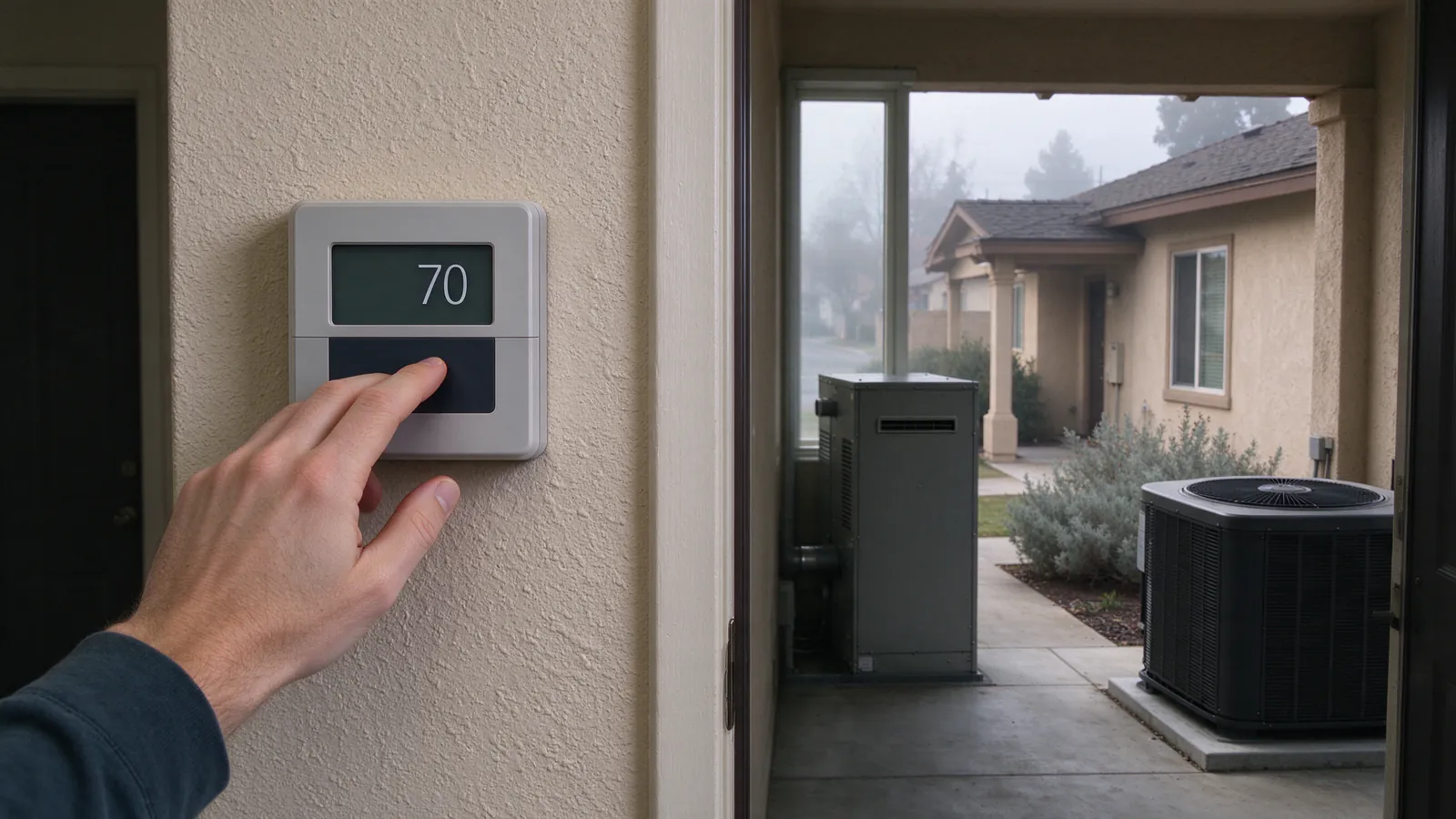
What is auxiliary heat?
Auxiliary heat is the backup inside your air handler: rows of electric heat strips sitting in the airflow just past the indoor coil. They add warmth when the heat pump alone cannot keep up, and the thermostat shows AUX or AUX HEAT while they run.
The heat pump warms the house by pulling heat from the outdoor air and moving it inside, which works well across a Bakersfield winter. When the strips come on, the heat pump keeps running and the strips add heat on top. At Veranda Bakersfield Heat Pumps we set up this backup as part of every heat pump installation we do.
AUX or EM HEAT: what is the difference?
The two labels sound alike, but they mean different things.
| Display | What is running | When you see it |
|---|---|---|
| AUX / AUX HEAT | Heat pump plus electric strips | Defrost, a big setpoint increase, or a heat pump that cannot keep up |
| EM HEAT / EMERGENCY | Electric strips only; outdoor unit off | Only when you choose it on the thermostat |
Auxiliary heat is automatic. Emergency heat is a manual setting you pick when the outdoor unit has stopped, is iced over in a way that does not clear, or has been damaged, and you need heat until we look at it.
Strips alone use far more electricity than the heat pump, so emergency heat is a stopgap, not a way to run the house.
When is it normal for the strips to come on?
During defrost
On cold, damp valley mornings, frost builds on the outdoor coil. The heat pump runs a defrost cycle: it reverses for a few minutes to warm the coil and melt the frost. You may see steam rising from the outdoor unit. While that happens, the strips come on so the air coming out of the vents does not turn cool.
After a setback
If you drop the thermostat at night and raise it a few degrees in the morning, many thermostats bring on the strips to close that gap quickly. A small setback in a mild Bakersfield winter rarely needs them. A large one often triggers them every morning.
On the coldest mornings
On a frosty morning in the low 30s, the heat pump has less heat to pull from outside, and it may need help until the sun comes up over the valley.
When is auxiliary heat a sign of trouble?
Long, frequent runs of auxiliary heat on mild days point to something else. A few common causes:
- The outdoor temperature lockout is set too high, so the strips are allowed to run when the heat pump could handle the load alone.
- The thermostat is not set up for a heat pump, or the wiring for the reversing valve and the strips is mixed up.
- The heat pump is low on capacity because of a refrigerant problem, a failed component or a dirty outdoor coil.
- Airflow is weak, from a clogged filter, a closed register or a duct problem, and the heat pump trips on its own safety controls.
You can check the filter and make sure the registers are open. Everything past that, including the thermostat’s installer settings and anything inside the equipment, is work for us. Our heat pump repair symptoms guide lists the safe observations to make before you call, and heat pump repair explains how we find the cause.
Which thermostat settings control backup heat?
Most heat pump thermostats have a set of installer settings that decide when the strips are allowed to run. These are the ones we check:
- Equipment type. The thermostat has to know it is driving a heat pump, with the right reversing valve setting, or it calls for the wrong thing.
- Outdoor temperature lockout. With an outdoor sensor, the thermostat can block the strips above a set temperature so the heat pump does the work.
- Staging and delay. The thermostat can wait a set time, or for the temperature gap to grow, before adding the strips.
- Setback recovery. Some thermostats bring on the strips to recover from a setback; others recover slowly using the heat pump alone.
- Strip stages. Larger air handlers split the strips into stages so only part of the backup runs when a little help is enough.
Communicating thermostats on variable-speed systems often handle much of this automatically. Our variable-speed guide explains why those systems lean less on backup heat. A home with a gas furnace as backup works differently again; see dual-fuel systems.
Why do the heat strips matter for your electrical panel?
Heat strips draw a lot of current, so their size sets the air handler’s circuit and uses up space in your electrical panel.
We size the strips to the house instead of picking the largest kit, which keeps the electrical work to what the house needs. Our electrical requirements guide covers the panel and circuit checks we make before an install.
What we leave you after startup
At startup we confirm the thermostat is set for the equipment, the strips stage on when called, the lockout matches the system, and defrost runs correctly. We record the readings and give them to you. The commissioning guide explains each check.
If your thermostat settings were never checked after an earlier install, or the AUX light seems to have a mind of its own, request an estimate or a maintenance visit. We look at the controls and tell you what we change before we change it.