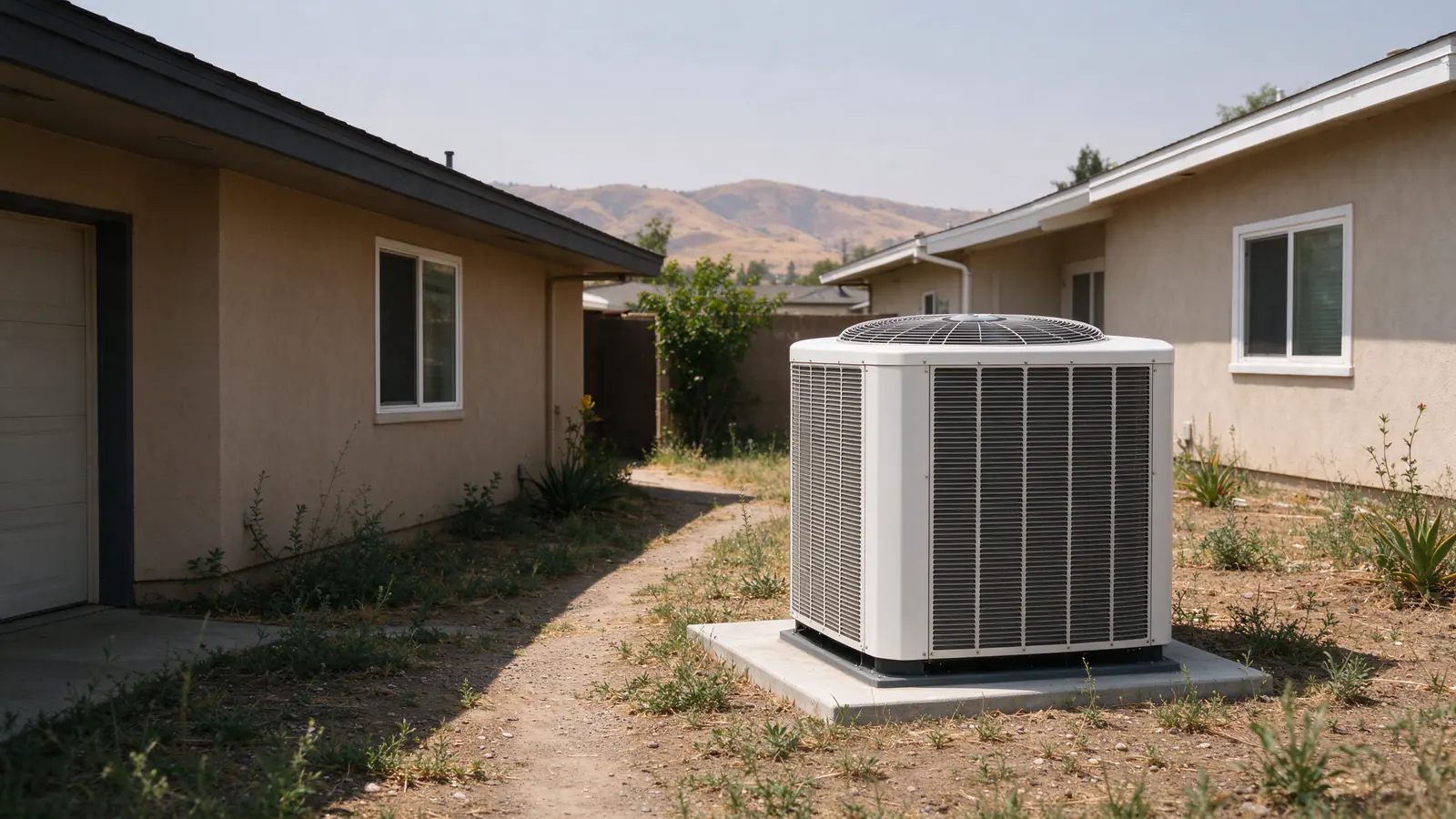
Is a heat pump just an air conditioner in summer?
Yes. In cooling mode a heat pump runs the same cycle as central AC: refrigerant picks up heat at the indoor coil, the compressor moves it outside, and the outdoor fan blows it away. A reversing valve flips the cycle for winter.
So the real question is whether your system is sized, ducted and placed to cool your house on the hottest afternoons. That is what Veranda Bakersfield Heat Pumps plans for on every heat pump installation.
How do we size for a 105-degree week?
We size from a load calculation using an industry method such as ACCA Manual J, with design conditions for Bakersfield. Those are the hot-afternoon temperatures the system is planned around, not the average summer day.
A system sized for an average day falls behind the week everyone remembers. The calculation also counts what makes your house hotter than the thermometer:
- West-facing windows and a dark roof.
- Thin attic insulation.
- Ducts running through that attic.
Then we choose equipment whose real cooling capacity at those conditions covers the load. Capacity on a label is measured at milder conditions, so we look at what the unit delivers at Bakersfield heat.
Oversizing is not the safe answer. A system that is too big short cycles, leaves rooms uneven and wears faster. Our sizing guide explains the balance.
Why do some rooms stay hot when the system is running?
When one or two rooms lag while the rest of the house is fine, the equipment is rarely the cause. The air is not getting there.
What we look at for a hot room
| What you notice | Common cause | What we check |
|---|---|---|
| West bedrooms hot every afternoon | Crushed or long supply run in the attic, plus afternoon sun | Supply run condition and airflow at the register |
| Whole back of the house warm | Undersized or single return | Return size, number of returns, static pressure |
| Weak airflow everywhere | Dirty filter, coil or blower, or high static pressure | Filter, coil, blower and duct pressure readings |
| Rooms fine in the morning, hot by evening | Ducts gaining heat in the attic | Duct insulation, leaks and disconnected joints |
Two recent jobs were airflow fixes, not bigger equipment:
- Rosedale: the 3-ton system was the right size, and the duct work that mattered was one crushed supply run to the west bedrooms, replaced in the same day.
- Shafter: the 4-ton size stayed the same and a second return was added.
Our guide to ductwork and airflow covers the details.
Do attic ducts really make that much difference?
Yes. On a summer afternoon your attic runs far hotter than the air outside, and every foot of duct up there sits in that heat.
- Leaks pull hot attic air into the return or blow cooled air into the attic.
- Thin insulation lets the duct warm the air on its way to the room.
That is why we check the ducts in the same visit as the sizing. A duct repair is often cheaper than moving up a size, and it fixes the actual problem. If ducts need work, it goes in the estimate as its own line.
Where does the outdoor unit belong in Bakersfield heat?
The outdoor unit gets rid of the heat it pulls from your house. If the air around it is hotter, it works harder and delivers less. Side yards here create a few common traps.
- Against a sunny west wall. Stucco in full afternoon sun radiates heat right into the coil.
- Under or near a dryer vent. Hot, damp air and lint go straight into the coil.
- Boxed in by fences or plants. The unit breathes its own hot exhaust air again.
- Dusty corners. Valley dust and blowing field dirt load the coil faster where air is trapped.
We place the unit with the manufacturer’s clearances on every side, room to service it, and the best airflow the yard allows. Our page on placement, sound and condensate has more.
What does normal July running look like?
On a 105-degree afternoon, a correctly sized heat pump may run for long stretches, sometimes without stopping for hours. That is normal and expected. The system is matching the heat pouring into the house.
What is not normal:
- The house keeps climbing through the afternoon even though the system is running.
- Air from the registers is barely cooler than the room.
- Ice on the refrigerant lines or the indoor coil.
- Water around the air handler or a ceiling stain under the attic unit.
- The outdoor fan is not spinning while the system runs.
If you see any of these, switch the system off at the thermostat and call us. Running a system with ice or no outdoor fan can damage the compressor. Our repair service and the guide to heat pump problems and what to check explain the next steps.
Does humidity matter in a dry valley summer?
It does on some days. Bakersfield summer air is mostly dry, but humid spells, monsoon moisture and a house full of people and cooking still put water in the air.
A correctly sized heat pump with long, steady runs pulls that moisture out at the coil. An oversized one short cycles and leaves the air feeling clammy even when the thermostat is satisfied. Our guide to humidity and cooling comfort explains how airflow and controls affect it.
How does startup prove the summer performance?
With readings. At startup we charge the system to the manufacturer’s specification, measure airflow and static pressure, and check the temperature drop across the indoor coil.
Those readings show the system is delivering the cooling it was designed for. You get them in writing, and we use them as the baseline at every maintenance visit. See startup and commissioning.
How do you keep it ready for next summer?
Dust and twelve-plus summers wear a system down. A clean outdoor coil, a clean filter and a clear condensate drain keep capacity where it was at startup.
Our maintenance service checks each of them before the heat arrives. When you are ready for a new system, request an estimate and we will set up the site visit.