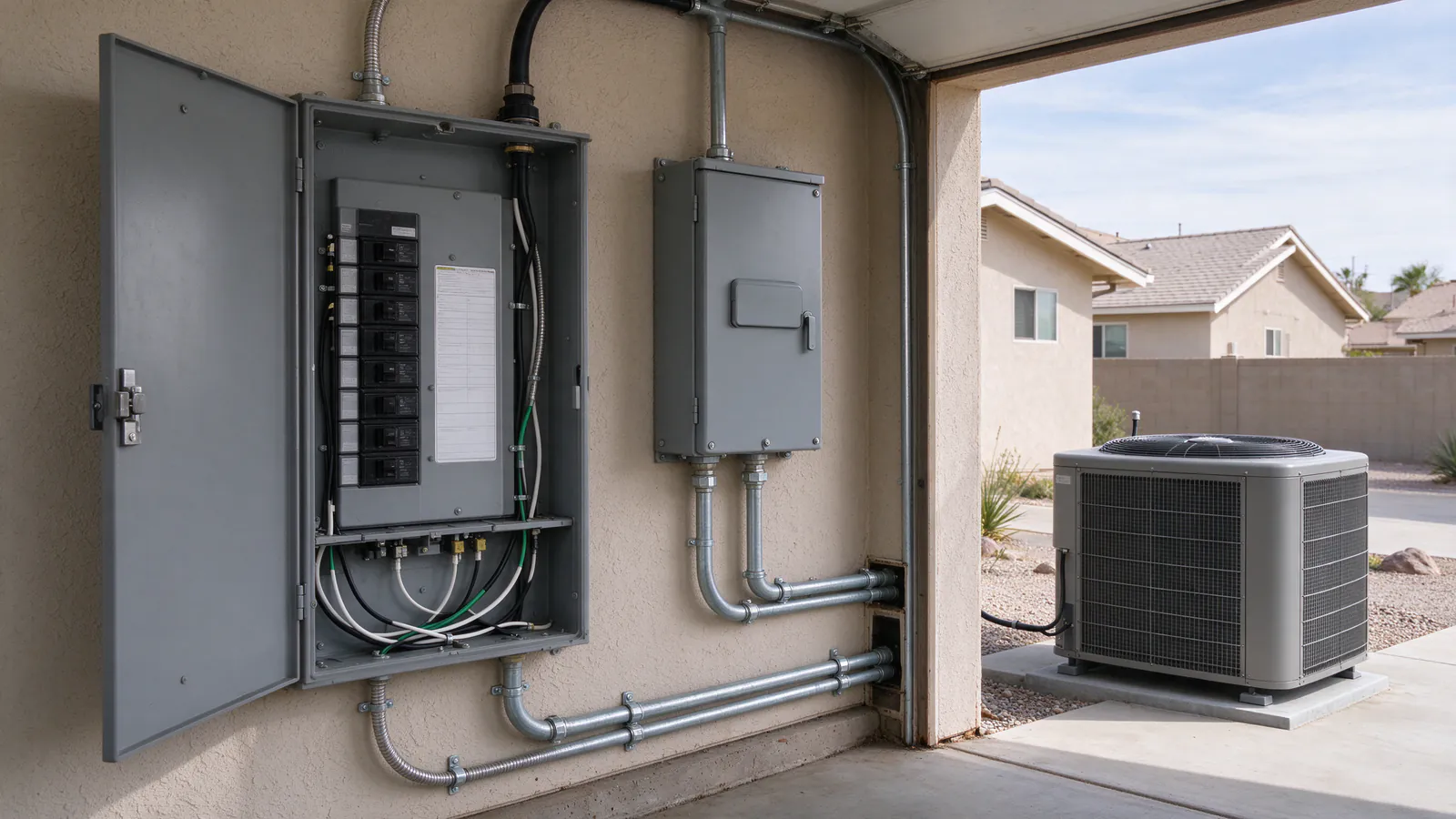
Will my panel handle a heat pump?
The answer comes from two numbers on your panel: how many open spaces it has and its service capacity. A panel can have empty slots and still be near its limit, for example after an EV charger, a pool pump or a kitchen remodel.
At Veranda Bakersfield Heat Pumps we open the panel at the site visit, read the main breaker and the directory, and look at what is already drawing power. That check shapes the electrical lines on the heat pump installation estimate before you see a price.
Choosing equipment around the panel
It also works the other way. Knowing what the panel can carry helps us choose the equipment. A variable-speed outdoor unit, a smaller heat strip bank or a different air handler can change the circuit sizes, and sometimes that choice keeps a panel upgrade off the estimate. Our variable-speed guide explains how those systems draw power.
Which circuits does a heat pump need?
A ducted heat pump has two pieces of equipment, and each gets its own supply.
| Equipment | Circuit | What sets its size |
|---|---|---|
| Outdoor unit | Dedicated 240-volt | The unit’s nameplate rating for minimum circuit size and maximum breaker |
| Indoor air handler | Dedicated 240-volt | The blower plus the electric heat strips, if fitted |
| Disconnect at the outdoor unit | On the outdoor circuit | Within sight of the unit, rated for the circuit |
| Thermostat | Low-voltage control wiring | The equipment’s control board |
The outdoor unit
If you are replacing a heat pump or an AC, there is already a 240-volt circuit and a disconnect in the side yard. We check that the wire size and breaker match the new unit’s nameplate, and that the disconnect is in good shape. Bakersfield sun and valley dust wear on these boxes, and a corroded disconnect gets replaced.
The air handler
This is where conversions differ most. A gas furnace runs on a small 120-volt circuit; an air handler with heat strips needs a dedicated 240-volt circuit sized for those strips.
A typical Oildale conversion needed exactly that: a new 240-volt circuit for the air handler in the hall closet, run from a panel that had room. Our conversion guide covers the rest of that job.
What happens if the panel is short on room or capacity?
There are several ways to handle it, and the right one depends on the house:
- Rearranging circuits. Sometimes tandem breakers or consolidating lightly used circuits frees a space, where the panel allows it.
- Choosing smaller heat strips. In a mild Bakersfield winter, a smaller backup heat bank can be enough, which lowers the circuit size.
- A subpanel. Adds spaces where the service has capacity but the panel is full.
- A panel or service upgrade. Needed when the service itself is too small. This involves the utility and takes longer to schedule.
We tell you which applies at the visit, and the estimate shows the electrical scope on its own line, so you can see what it adds.
If you are replacing a heat pump that already has both circuits, the electrical side may be no more than a check and a new disconnect. Veranda’s typical range for a like-for-like ducted heat pump replacement is $6,500 to $15,500, set at the site visit.
Why does the thermostat matter so much?
The thermostat is the brain of a heat pump. It tells the outdoor unit when to run, flips the reversing valve between heating and cooling, and decides when the backup strips come on. A plain AC and furnace thermostat cannot do all of that.
Wiring
An old AC and furnace may have used four or five wires. A heat pump with backup heat typically needs more, including a common wire to power a modern thermostat. If the existing cable is short of conductors, we run a new one.
Settings
The settings that matter most are the backup heat lockout and the balance point, which together decide how often the strips run. Set badly, the strips do the heat pump’s job and the bill shows it. Our guide on auxiliary heat and thermostat controls explains what we set and why.
Communicating systems
Some variable-speed systems use a communicating thermostat that talks to both units over a data connection. These need the matching thermostat from the same equipment line. Our matching guide covers how controls fit into the matched set.
How does the electrical work get coordinated?
We schedule the electrical work with the rest of the installation so the circuits are ready when the equipment arrives. It sits inside the same project and permit, and the inspection covers it.
The permit office depends on the address, so we check it before filing, and the permit is a line in your written estimate. Our permits guide explains the process.
What do you need to do?
Very little. Before the visit, photograph the panel’s main breaker and directory, and the thermostat. On install day, clear the area in front of the panel and leave the panel cover on; the breakers and wiring behind it are for us.
- Tell us about plans for an EV charger or another large load; it changes the capacity picture.
- Check where your house stands with our system readiness tool.
After startup we record the voltage and amp draw on both units and give you the readings. The commissioning guide shows what else we check. To get the panel looked at, request an estimate or call (661) 269-7726.