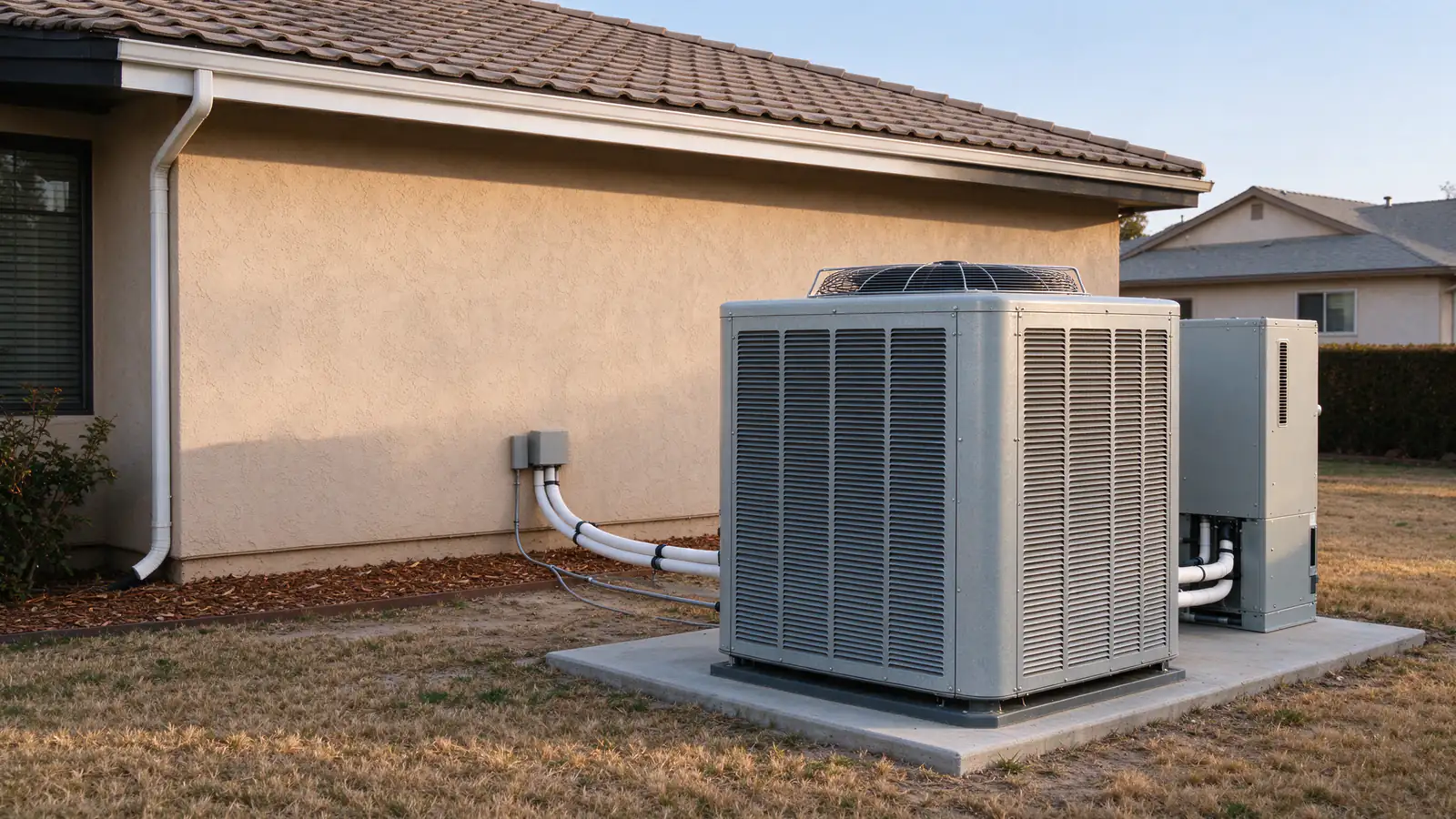
Why does the house swing between too cold and too warm?
Because a single-speed system has one output, full, and the thermostat can only turn it on or off. You set 76, it blasts cold air until the hallway hits 74, then shuts off. Twenty minutes later the west bedroom is near 80 again.
A variable-speed heat pump handles the same afternoon differently:
- It ramps up when the sun is on the west wall.
- It then slows down and keeps running at a lower output instead of stopping.
- The air keeps moving, the rooms stay closer together, and the blast-then-stall feeling goes away.
It is one of the choices Veranda Bakersfield Heat Pumps lays out during a heat pump installation visit.
What changes between single-stage, two-stage and variable-speed?
All three move heat the same way. The difference is how many speeds the compressor and indoor fan have to work with.
| Type | How it runs | What you notice |
|---|---|---|
| Single-stage | One speed: full on or off | Short, strong cycles; wider temperature swings between rooms |
| Two-stage | A low stage for most hours, a high stage for peak heat | Longer, quieter runs; high stage kicks in on the hottest afternoons |
| Variable-speed | Many small steps from low output up to full | Long, steady runs; the most even temperatures and the most moisture removal |
None of the three is the right answer for every house. A well-sized single-stage system on good ducts can keep a small house comfortable. A variable-speed system on a crushed, undersized duct run will still leave one room hot.
What does variable speed feel like in a Bakersfield summer?
Long, quiet afternoons
During a 105-degree week, a variable-speed system climbs to full output in the late afternoon, the same as any other. The difference shows up the rest of the day.
Through the morning and evening it runs slowly for long stretches, so the house holds a steady temperature and the outdoor unit hums instead of cycling on and off beside your patio.
Drier, less clammy air
Air that moves slowly across a cold indoor coil gives up more of its moisture. Bakersfield summers are mostly dry, but a house full of people, cooking and showers still builds up humidity indoors. Longer, lower runs pull more of that out. Our guide to humidity and cooling comfort explains how runtime and fan speed work together.
Mild winters and cold valley mornings
On a foggy January morning the house needs only a little heat. A variable-speed unit can deliver that little bit for a long time instead of short bursts of warm air. That also keeps the auxiliary heat strips from switching on when the heat pump alone can carry the load.
What has to be right for variable speed to work?
The extra speeds only help if the rest of the system can use them. Before we put a variable-speed option on an estimate, we check these items at the house:
- Sizing. We run a load calculation from the house itself: square footage, windows, insulation, orientation and the attic. Oversized equipment, even variable-speed, spends too much time at its lowest step and too little time doing useful work. Our sizing guide walks through the method.
- Ducts and return air. Low speeds move less air, and leaky or crushed ducts in a hot attic waste a bigger share of it. We look at duct condition, return air and static pressure. See ductwork and airflow for what those checks mean.
- A matched indoor unit. Variable-speed outdoor units are built to run with specific air handlers or coils. A mismatched pair can lose the very features you paid for.
- Controls. Many models need their own communicating thermostat and wiring. We confirm what the model requires and put it on the estimate.
- Electrical. We check the panel and the circuit the outdoor unit needs, as we do for any heat pump.
Will a variable-speed heat pump lower your power bill?
It can, but no single number applies to every house. A variable-speed system often uses less power in the mild stretches of the year, running at a low, efficient output instead of starting and stopping.
During the peak of a Bakersfield summer, every system works hard. What moves your own result:
- How well the ducts hold air and how much of the duct run sits in the attic.
- How the equipment is sized against the real load of the house.
- How you set the thermostat, and whether you let it ride or make big setbacks.
- Your electric rate plan and when during the day the system does most of its work.
Our operating cost guide and the operating cost comparison tool let you test those inputs for your house before you decide.
How do we help you choose?
We start with a site visit, not a phone quote. We measure the house, look at the ducts in the attic, check the return air and the electrical panel, and look at where the outdoor unit will sit. Then we write it up.
The written estimate lists:
- The model numbers, the size and why we chose it.
- Any duct or electrical work, and the permit.
- Removal and disposal of the old system, and the startup checks.
- A variable-speed or two-stage option, priced on its own line when it makes sense for your house, so you can compare it against the standard choice.
If your current system is near the end of its life, our heat pump replacement page covers how a like-for-like swap works. Veranda’s typical range for a like-for-like ducted heat pump replacement is $6,500 to $15,500.
When you are ready, request an estimate and tell us which rooms give you trouble. That tells us where to look first.