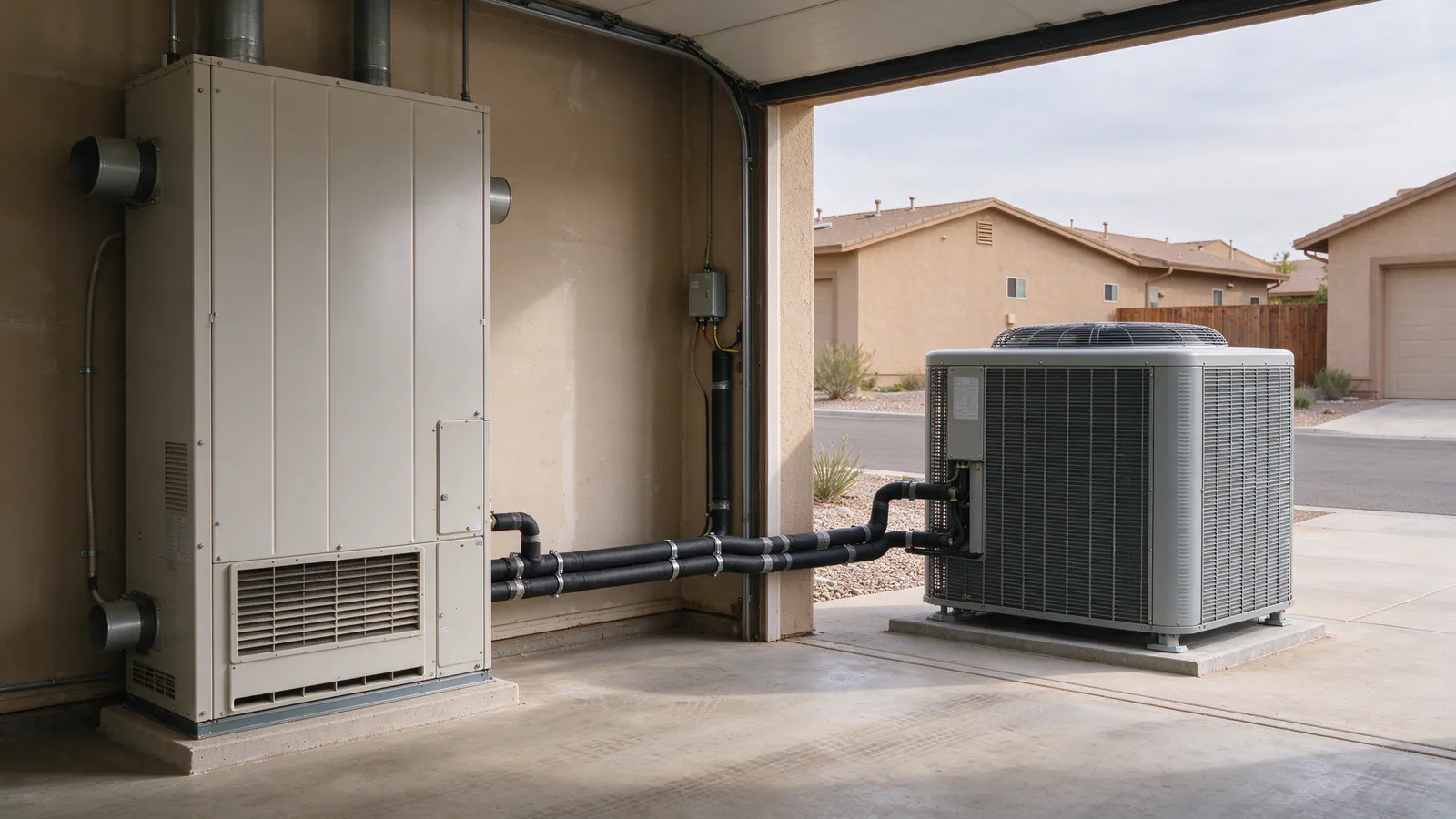
Why can’t the outdoor unit be swapped on its own?
The outdoor unit is only half of the refrigerant circuit. The other half is the indoor coil in the air handler, and the two coils have to be built to work together: the right surface area, the right metering device and the right refrigerant.
Manufacturers rate a heat pump’s capacity and efficiency as a pair, and industry directories such as the AHRI directory list those rated combinations by model number. A combination that is not listed may still run, but nothing tells you what capacity or efficiency it delivers.
What goes in our quote
At Veranda Bakersfield Heat Pumps, every heat pump installation we quote names both model numbers and pairs them as a rated combination.
What happens when the pair is mismatched?
The problems show up slowly, which is part of why mismatches happen. A mismatched system can:
- Deliver less cooling than the outdoor unit’s label suggests, which shows on a 105-degree afternoon.
- Run the indoor coil too cold, so it freezes in summer.
- Leave the compressor running at the wrong pressures, which shortens its life.
- Struggle with humidity because the coil and airflow are not balanced.
- Trip safety controls, which looks like random shutdowns.
An older system that has had one half replaced after a failure can end up in this state. If your house never cooled quite right after an earlier repair, a mismatch is one of the things we check. Our repair or replace guide explains how that weighs into the decision.
What has to match?
Several parts have to agree for the system to run as rated.
| Part | Why it matters | What we check |
|---|---|---|
| Outdoor unit | Sets the compressor capacity and the refrigerant | Size from the load calculation, refrigerant type |
| Indoor coil | Has to absorb and release the heat the outdoor unit moves | Model, size and rated pairing with the outdoor unit |
| Metering device | Controls refrigerant flow into the coil | Type and size for the refrigerant and the pair |
| Air handler blower | Moves the air the pair is rated at | Blower capacity and settings against the duct static pressure |
| Refrigerant lines | Carry refrigerant between the two | Diameter, length, condition and route |
| Thermostat and controls | Run the stages, the reversing valve and the backup heat | Compatibility, wiring and settings |
The indoor coil and air handler
In a ducted heat pump system, the coil sits inside an air handler in a closet, garage or attic. We choose the air handler as part of the pair so the coil, the blower and the heat strips suit the outdoor unit and the house.
The blower also has to suit your ducts: a rated pair only reaches its numbers at its rated airflow, which is why we measure static pressure as well. Our ductwork and airflow guide explains that test.
The refrigerant
Equipment made for one refrigerant cannot simply be filled with another, and the oils inside differ too. Older systems may use a refrigerant that newer outdoor units do not. In that case the indoor coil has to change too, and the lines need flushing or replacing.
Can the old refrigerant lines stay?
Sometimes. Lines can stay when they are the right diameter for the new equipment, the route is sound and the copper and insulation are in good shape.
In a Bakersfield attic or along a sun-baked wall, the insulation jacket is often cracked or missing, and we replace it even when the copper stays. The lines themselves get replaced when:
- The size is wrong for the new equipment.
- They are kinked or damaged.
- The refrigerant change calls for it.
- The outdoor unit moves to a new spot.
Either way, we pressure-test the joints and pull a vacuum before releasing refrigerant into the system.
How does sizing fit into matching?
Matching starts with the right size. We run a load calculation from the house’s size, windows, insulation, orientation and attic, then pick an outdoor unit for that load and a rated indoor match. Our guide on how heat pump sizing works explains the calculation.
Sometimes the right answer is the same size as before. A typical Shafter replacement kept its 4-ton size on a 2,100 sq ft single-story house, added a second return so the new pair could move its rated airflow, and came to $14,200 over two days on site.
What about variable-speed systems?
Variable-speed outdoor units adjust their compressor speed to the load. To use that range, they often need a variable-speed air handler and a communicating thermostat from the same equipment line.
The three talk to each other over a data connection, and swapping in a different thermostat can lock the system into fewer stages. Our variable-speed guide compares the options without the sales talk.
How do we confirm the pair is working?
At startup we check refrigerant pressures and temperatures, superheat or subcooling for the metering device, airflow and static pressure, and the temperature change across the coil. We record those readings and hand them to you. The commissioning guide walks through each step.
Veranda’s typical range for a like-for-like ducted heat pump replacement is $6,500 to $15,500, set at the site visit and written into the estimate with both model numbers. If you are converting from a gas furnace, the conversion guide covers how the air handler choice fits the old furnace space. To get your system checked, request an estimate or call (661) 269-7726.