What is the short answer?
Veranda’s typical range for a like-for-like ducted heat pump replacement is $6,500 to $15,500. At Veranda Bakersfield Heat Pumps, your exact price comes from a site visit and a written estimate.
If you are replacing a gas furnace and central AC with a heat pump instead, that is a conversion: Veranda’s typical range for a furnace-and-AC conversion is $8,000 to $15,500. Both ranges cover a complete, working ducted system, sized for your house, permitted, started up and checked. Our heat pump replacement service page explains what the job includes.
Why is the range so wide?
Because Bakersfield houses are not alike, and the work each one needs is not alike either.
- Near the low end: a small single-story ranch with sound ducts, an easy hall-closet air handler and a panel with room.
- Near the top: a larger house that needs variable-speed equipment, duct repairs in a hot attic, a second return and electrical upgrades.
The equipment itself is only part of the price. Labor, ductwork, electrical, the permit, disposal and startup all add up, and how much of each your house needs is what we work out on site.
What pushes a price up or down?
Mostly the house, not the equipment brand. Each row below is something we check at the visit, and each one can move your price toward the low or the high end of the range.
| Factor | Pushes the price toward | What we check |
|---|---|---|
| System size | Higher for larger tonnage | A load calculation from your house: size, windows, insulation, orientation and attic |
| Equipment type | Higher for two-stage and variable-speed | How you use the house and whether the ducts can support the equipment |
| Duct condition | Higher when runs are crushed, leaky or undersized | Static pressure, visible damage in the attic, supply runs to hot rooms |
| Return air | Higher when a return has to be added or enlarged | Number and size of returns, grille restriction |
| Electrical | Higher when a new circuit, disconnect or panel work is needed | Panel space, service size, existing circuits |
| Air handler location | Higher for tight attics and hard-to-reach closets | Access, working room, condensate drain path |
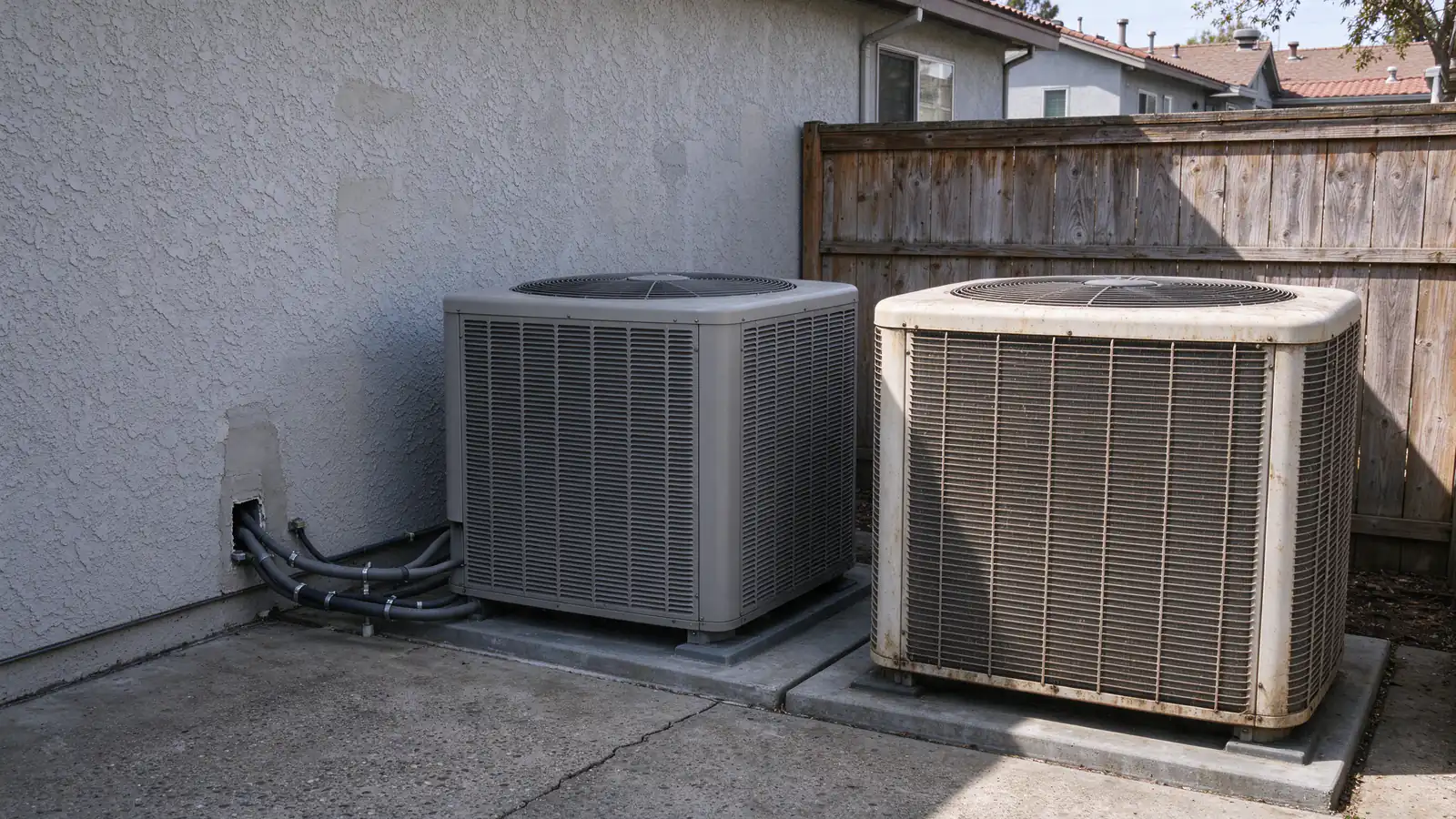
| Outdoor placement | Higher when the unit moves or the line run gets longer | Clearances, pad, distance to the indoor unit, sun and dryer vents |
| Thermostat and controls | Higher when the old thermostat cannot run a heat pump | Wiring and compatibility with the new equipment |
| Conversion from gas | Higher than a like-for-like swap | Furnace removal, gas line capping, new air handler and circuit |
Which of these matters most in Bakersfield?
Ducts and size. Attic ducts in Bakersfield sit in heat well above the outdoor temperature on a summer afternoon, and a crushed or leaking run there costs you cooling every day. Size matters because the wrong size cannot be fixed later without replacing the equipment. Our guide to heat pump sizing explains how we calculate it.
What’s inside a Bakersfield heat pump replacement price?
Ten parts make up the price, from the outdoor unit to the startup checks. Here is what sets each one and what we confirm on site before it goes on your estimate.
| Part of the price | What sets it | What we confirm on site |
|---|---|---|
| Outdoor unit | Size, efficiency and single-stage, two-stage or variable-speed | The size from the load calculation and the right placement |
| Indoor air handler or coil | Matched to the outdoor unit; size and blower type | Where it sits, how it fits, and the condensate drain |
| Refrigerant lines | Whether existing lines can be reused or need replacing | Line size, condition and the run length |
| Ductwork | Repairs, replaced runs, added returns, transitions | Static pressure, return air, damaged or crushed runs |
| Electrical | Circuits, breakers, disconnect, wiring | Panel space and condition, existing circuits |
| Thermostat | Whether a compatible one is already there | Wiring and heat pump settings |
| Permit | The office that covers your address | Your address, checked before the permit is filed |
| Labor | Hours for the full scope, access and conditions | Attic access, closet room, side-yard path |
| Removal and disposal | Old equipment out, refrigerant recovered | What is coming out and how it gets to the truck |
| Startup and checks | Charging, airflow, temperature and mode tests | Readings recorded and handed to you |
None of these parts is a surprise added later. Each one is a line in your written estimate, with the reason it is there.
What do typical replacement budgets look like?
Here is how scope moved the price on three jobs in our service area.
| Job | House | Scope | Budget | Time on site |
|---|---|---|---|---|
| Rosedale ducted replacement | 1,700 sq ft single-story ranch | 3-ton heat pump replaced; one crushed supply run to the west bedrooms replaced | $11,000 | 1 day |
| Oildale furnace-and-AC conversion | 1,300 sq ft 1950s house | Air handler in the hall closet; new 240-volt circuit; panel had room; gas line capped | $12,400 | 2 days |
| Shafter replacement with second return | 2,100 sq ft single-story | Same 4-ton size kept; second return added | $14,200 | 2 days |
What do these jobs tell you?
- Rosedale sat in the middle of the range: a standard size, sound equipment location and one duct repair. Replacing the crushed run to the west bedrooms was the only duct work it needed.
- Oildale cost more than its floor area suggests, because a conversion brings furnace removal, a new air handler and a new circuit. The panel having room kept it from climbing further.
- Shafter kept the same size after the load calculation confirmed it, so the extra cost went into a second return. Adding return air costs less than moving up a size, and it is the fix when the house is short of return, not short of capacity.
See our pages on Rosedale, Oildale and Shafter for the work we do in each.
How is our written estimate laid out?
Every replacement estimate follows the same order, so you can compare it line by line.
- The equipment. Model numbers for the outdoor unit and the indoor air handler or coil, the size, and why we chose that size.
- Ductwork. Each repair, replaced run or added return, and what it fixes.
- Electrical. Circuits, disconnect, breakers and any panel work.
- Thermostat and controls. Whether yours stays or a compatible one goes in.
- Permit. Filed with the office that covers your address.
- Removal and disposal. The old equipment, with refrigerant recovered.
- Startup checks. The readings we take and hand over.
- Optional upgrades. Priced separately, so you can say yes or no to each.
- Rebates. If a program fits your house, it shows on its own line.
Nothing on the estimate is replaced or added without your say, and if we find something during the job that changes the scope, we tell you the cost before we do it. Our replacement planning checklist helps you get ready for the visit, and comparing heat pump estimates shows how to read two quotes side by side.
Do rebates lower the price?
They can. Programs depend on your address, your utility, the equipment and funding. When we visit, we tell you what we know applies to your house, and any rebate shows on its own line.
We never count a rebate in your price until it is approved. The price you sign is the price you pay; a rebate that comes through is money back on top of that. Our guide to heat pump incentives near Bakersfield covers how we check.
Is it time to replace, or can it be repaired?
If your heat pump still runs, a repair may be the better call. Age, refrigerant leaks, compressor condition and how many summers it has left all play in.
Twelve-plus Bakersfield summers wear a system down, but age alone does not decide it. Our guide to repair or replacement walks through the decision, and the repair-or-replace tool gives you a starting point.
Ready for a number on your house?
When you are ready, try the cost estimator or request an estimate and we will set up the site visit.