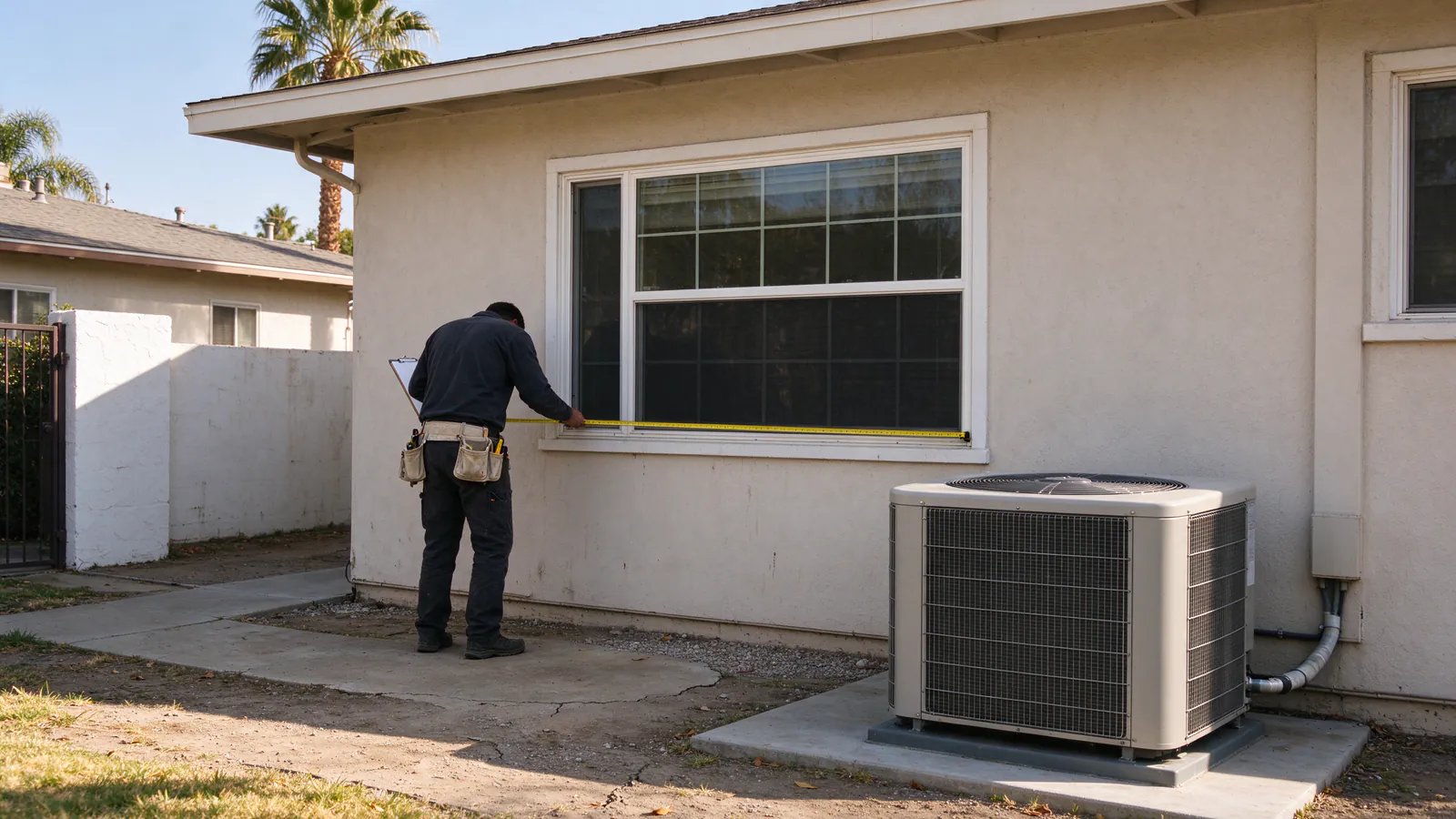
Why can’t you size a heat pump by square footage?
Because two houses with the same floor area can need different equipment. A “one ton per so many square feet” rule ignores what decides how hot a house gets on a Bakersfield afternoon: window direction and size, attic insulation, and ducts in that attic.
Take two 1,700 square foot single-story ranch houses on the same street:
- House one faces east, with shaded windows and deep attic insulation.
- House two has a wall of glass facing west and thin insulation over the bedrooms.
The second house can need noticeably more cooling, and a square-foot rule would size them the same. At Veranda Bakersfield Heat Pumps, sizing is the first step of every heat pump installation, because it is the choice that is hardest to undo.
What is a load calculation?
A load calculation works out how much heat your house gains on a hot day and loses on a cold one. The industry method for houses is ACCA Manual J.
It adds up the heat moving through each wall, window, ceiling and floor, plus heat from air leaks, people, appliances and the ducts, using design temperatures for your area.
What do we measure at your house?
| What we measure | Why it matters |
|---|---|
| Floor area and ceiling heights | The volume of air the system conditions |
| Window sizes, glass type and direction | West and south glass bring in the most afternoon heat |
| Wall and attic insulation | How fast heat moves through the shell |
| Which way the house faces | Sets when and where the sun hits hardest |
| Attic conditions | A hot attic pushes heat down through the ceiling |
| Duct location and condition | Ducts in a hot attic gain heat before air reaches the room |
| Air leaks and doors | Outside air that sneaks in has to be cooled |
| How you use the rooms | A busy kitchen or a home office adds heat |
What happens when a heat pump is too big?
An oversized heat pump cools the air near the thermostat quickly, then shuts off. A few minutes later the house warms and it starts again. That pattern, short cycling, causes problems you can feel.
- Temperature swings. The thermostat area cools fast while back bedrooms lag.
- Less moisture removed. Short runs never let the coil pull much water out of the air. Bakersfield summer air is mostly dry, but humid spells and evening watering still show it.
- More wear. Every start is hard on the compressor and electrical parts.
- Noise and drafts. Bigger equipment pushes more air through ducts sized for less.
Our guide to humidity and cooling comfort explains the moisture side in more detail.
What happens when it is too small?
An undersized heat pump runs and runs on a 105-degree afternoon and still lets the house climb. In winter, an undersized system leans harder on its auxiliary heat strips on cold valley mornings, which costs more to run.
See heat pumps in Bakersfield summer heat for what to expect in July.
Do the ducts change the size?
They change what the size can deliver. A correctly sized heat pump still underperforms if the ducts cannot carry its airflow, and a crushed run, a small return or leaky attic joints all cut cooling.
That is why we check ducts in the same visit. If a duct problem is the reason a room runs hot, fixing the duct is the answer, not a bigger heat pump.
Our guide to ductwork and airflow goes into static pressure and return air.
Does variable-speed equipment change the sizing?
The load calculation is the same. What changes is how the equipment meets it.
- Single-stage runs at full output whenever it runs.
- Variable-speed can slow down well below its top capacity, so on a mild day it runs gently instead of short cycling.
That gives a variable-speed system more room for error at the low end, but it does not make oversizing harmless or let us skip the calculation. Our variable-speed guide explains the trade-offs.
How does the size reach your estimate?
Once we have the loads, we choose a matched outdoor unit and indoor air handler or coil whose rated capacity covers them at Bakersfield conditions. The written estimate lists:
- The model numbers of both pieces of equipment.
- The size, in tons.
- Why that size: the loads it covers and anything about the house that drove it.
- Any duct or return work that the size depends on.
If the calculation lands on the same size as your old unit, we say so. If it lands on a different one, we explain what changed.
On a Shafter house of 2,100 square feet, the calculation confirmed the existing 4-ton size, and the money went into a second return instead. Matching matters as much as size; see matching indoor and outdoor equipment.
What can you do before we visit?
A few things help the calculation and save time.
- Note which rooms run hot or cold, and at what time of day.
- Find any paperwork on window replacements or added insulation.
- Clear a path to the attic hatch and the air handler closet.
- Take a photo of the outdoor unit’s label if you have one handy.
Our list of what to gather before an estimate covers the rest, and the installation guide shows where sizing fits in the whole job.
Our system assessment tool walks you through the same questions. When you are ready, request an estimate and we will set up the site visit.