Why does a little prep make a difference?
A heat pump estimate is only as good as what we see on the visit. If you gather a few things first, we spend that time on your house instead of digging for labels behind a water heater, and you get your written estimate sooner.
On the visit we check:
- The size of the house and which way it faces.
- The ducts and the return air.
- The electrical panel.
- Where the outdoor unit can sit.
This list works whether you are planning a heat pump installation, a heat pump replacement or a move off a furnace and AC.
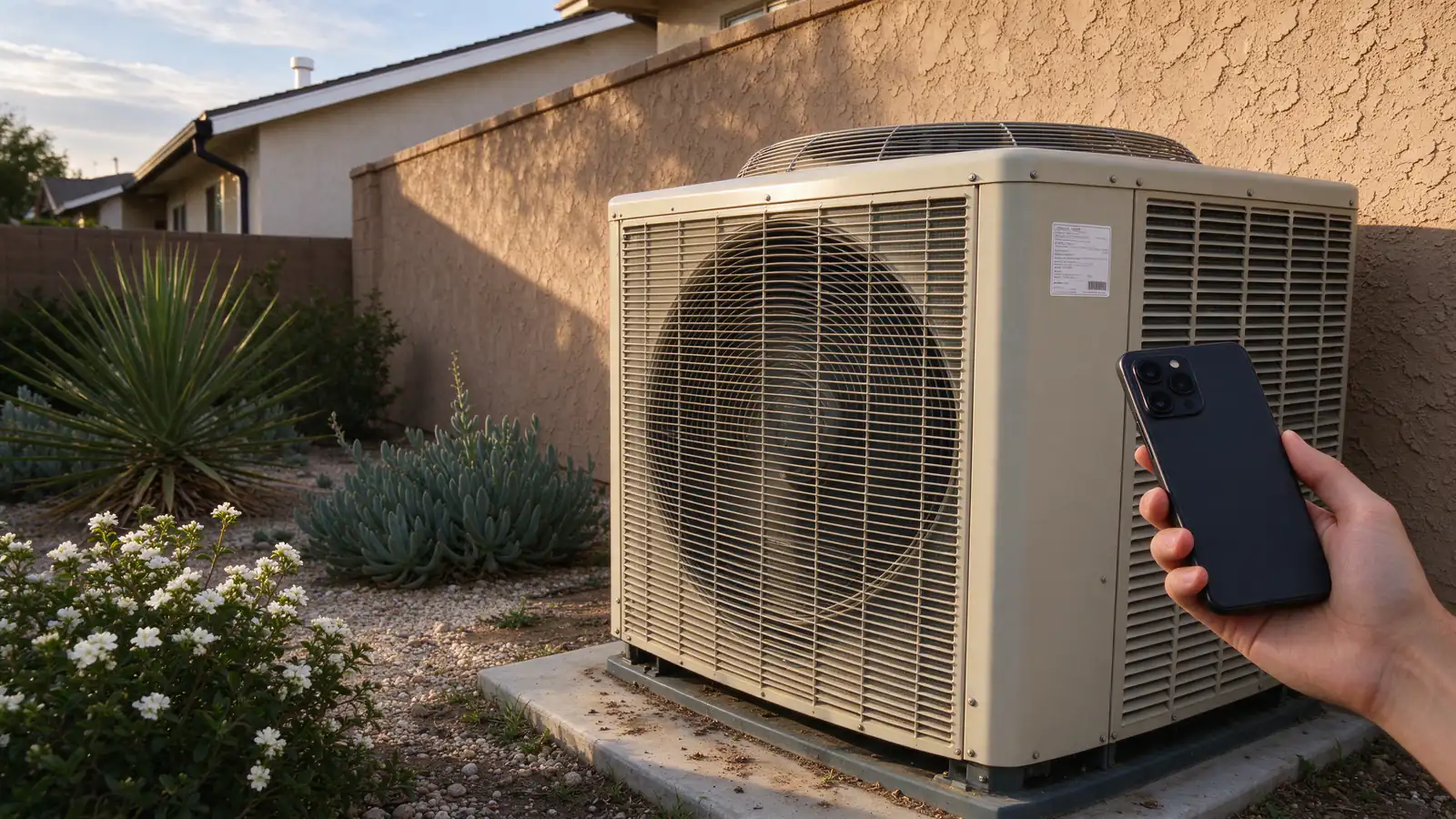
What labels do I photograph?
Use your phone. Leave every panel on and stay clear of wiring. All we need is a clear shot of each sticker.
| Equipment | Where the label usually is | What it tells us |
|---|---|---|
| Outdoor unit (AC or heat pump) | Side panel near the service valves | Model, serial, size, electrical ratings |
| Furnace or air handler | Inside the closet or garage, on the cabinet front or side | Type, size, age |
| Indoor coil | On the metal box above or below the furnace | Whether it matches the outdoor unit |
| Electrical panel | Inside the panel door | Main breaker size and open spaces |
| Thermostat | Front of the screen, and the model under it | Whether it can run a heat pump |
The serial number often holds the build date, so these photos also tell us the age of the system. If you are on a furnace and AC now, the furnace label matters most. Our guide to changing from a furnace and AC to a heat pump explains why.
Which comfort problems do I write down?
Your notes on how the house feels shape the load calculation. Write down what you notice, in plain words:
- Rooms that never cool on a 105-degree afternoon, and which side of the house they face.
- Rooms that stay cold on a foggy January morning.
- Registers with weak airflow, or a return grille that whistles.
- Dust on furniture a day after cleaning.
- Any part of the system that cycles on and off often, or never stops in July.
A hot west bedroom often points to a duct problem rather than a small unit. Our page on ductwork and airflow covers what we look for.
Do I need my utility bills?
Yes, if you have them. Bring twelve months of electric bills, and gas bills if you heat with gas now. They show how hard the current system works through a Bakersfield summer and a cold valley winter.
The bills also help us talk through heat pump operating cost with you, using your actual use instead of a guess. Your account details tell us which utility serves the address, which affects rebate programs.
What about access to the house?
A few practical details save time on the day:
Side yard and outdoor unit
Tell us if the side gate is locked or the unit sits behind a fence. Note anything near it: a dryer vent, a hot west wall, a pool pump. Placement shapes sound, airflow and service access, and our page on outdoor unit placement explains why.
Attic and closets
Show us where the attic hatch is and clear a path to it. If the furnace or air handler sits in a hall closet, move what is stored in front of it.
Pets, parking and the panel
Let us know about dogs in the yard. Tell us where the electrical panel is, and whether anything has been added recently, such as an EV charger, a spa or solar. Panel room decides whether the job needs a new circuit or more. Our guide to electrical checks before installation has the detail.
What do I leave to us?
You do not need to know the right size, the duct condition or the permit office. We run the load calculation, test the airflow and check the address before the permit is filed. The permit is a line on the written estimate.
We converted an Oildale house from the 1950s: 1,300 sq ft, with the air handler in the hall closet. The panel had room for the new 240-volt circuit, and we capped the gas line. That job came to $12,400 and two days on site. Your panel photo tells us early whether your house can go the same way.
What happens after the visit?
You get a written estimate that spells out the job line by line, so you can see what you are paying for. It lists:
- Model numbers, and the size we chose and why.
- Duct and electrical work.
- The permit.
- Removal and disposal of the old equipment.
- Startup checks.
- Any optional upgrades, priced separately.
Veranda’s typical range for a like-for-like ducted heat pump replacement is $6,500 to $15,500, and for a furnace-and-AC conversion it is $8,000 to $15,500. The estimate sets your number.
When you have it, our estimate comparison post helps you read it line by line. To book, call (661) 269-7726 or request an estimate.