Why does a little homework help?
A heat pump replacement estimate is only as precise as the information behind it. A few notes and photos from you keep the estimate from Veranda Bakersfield Heat Pumps tied to your actual house.
We measure the house, check the ducts and open the panel at the visit. But you know things we cannot see in an hour: which bedroom never cools, when the bills spike, whether the breaker trips on hot afternoons.
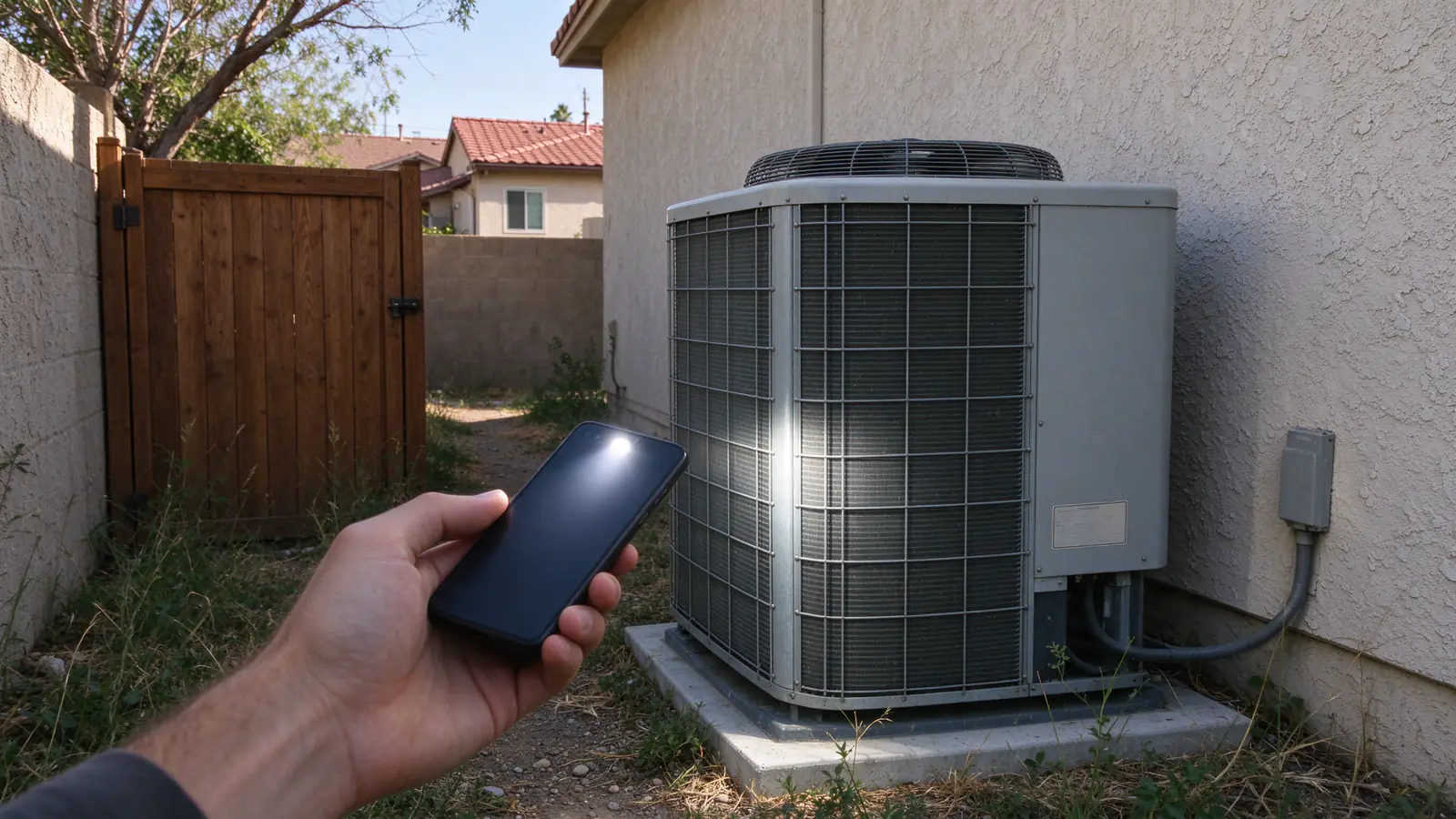
Which labels do we need photos of?
Every piece of equipment has a nameplate. Together they tell us the size, the age, the refrigerant and the electrical rating of what you have now.
| Where | What to look for | What it tells us |
|---|---|---|
| Outdoor unit | Sticker on a side or back panel with model and serial numbers | Size, age, refrigerant type |
| Indoor unit (air handler or furnace) | Label inside or on the door panel; leave the panels on and photograph only what you can see | Blower size, heat strip rating, coil match |
| Thermostat | The brand and model, plus a photo of the wires if the faceplate lifts off easily | Whether it can run the new system |
| Electrical panel | The main breaker label and a photo of the breaker directory | Service size and open spaces |
| Disconnect box near the outdoor unit | The box itself and any label inside the cover | Circuit size and condition |
If a label is faded or missing, photograph what is there. We read the rest on site.
Which rooms bother you, and when?
Walk the house and jot down anything that has annoyed you, even if it seems minor:
- Rooms that stay hot on summer afternoons, and which side of the house they face.
- Rooms that run cold on winter mornings.
- Vents with weak airflow or a whistle.
- Dust that builds up faster than it seems it ought to.
- Noise from the indoor unit or ducts.
- Breakers that trip, or lights that dim when the system starts.
A west bedroom that will not cool tends to point to the duct run feeding it, and our ductwork and airflow guide explains what we test. A typical Rosedale replacement turned on exactly that: one crushed supply run to the west bedrooms, replaced on the same day as the 3-ton system.
What access do we need on the day?
The estimate visit covers the whole system, so we need to reach every part of it:
- Attic hatch. Clear the closet shelf or hallway below it.
- Side yard or backyard. Open the gate and secure pets.
- Electrical panel. Clear boxes or shelving in front of it.
- Indoor unit. Hall closet, garage corner or attic platform, with room to open the panels.
- Thermostat. No preparation needed.
Tell us about anything that makes access harder: a narrow side yard, a unit against a hot west wall, a dryer vent blowing onto the outdoor coil. Those details shape the placement plan, and our guide to outdoor unit placement and sound explains what we weigh.
What do we do at the visit?
We start by listening to your list, then work through the house in order. Each step feeds a line on the written estimate.
- Load calculation. We use the house’s size, windows, insulation, orientation and attic, because the old unit’s size is only a starting clue. Our guide on how heat pump sizing works explains why square footage alone cannot size a system.
- Airflow and ducts. We check the ducts, the return air and the airflow at the registers.
- Electrical and placement. We look at the panel and where the outdoor unit sits.
- Permit. We check the address before the permit is filed, because the permit office depends on it. Our permits guide explains the steps.
If something needs a closer look, such as a duct run we cannot reach or a panel label we cannot read, we tell you before the estimate goes out rather than guessing at it.
What will the written estimate show?
The estimate lists each piece of work on its own line, so you can see what you are paying for:
- Model numbers for the outdoor unit and the indoor unit, the size and why we chose it.
- Duct work, if any, and what it fixes.
- Electrical work, if any.
- The permit.
- Removal and disposal of the old equipment.
- Startup checks, with the readings we record when the system first runs.
- Optional upgrades, priced separately.
Veranda’s typical range for a like-for-like ducted heat pump replacement is $6,500 to $15,500. The site visit sets where your house falls in it. Our replacement cost guide shows the factors that move it.
Which questions are worth asking us?
Bring these along, or ask us when the estimate arrives:
- Why this size, and what did the load calculation show?
- Are the indoor and outdoor units a matched pair?
- What duct work is included, and what did you find in the attic?
- Does the panel have room, or does the electrical scope change?
- What will the thermostat do with the backup heat?
- Which rebates might apply at this address? We never count a rebate in your price until it is approved, and a program shows on its own line.
- What readings will you record at startup?
If you are still weighing whether to fix the old system, start with our repair or replace guide. For a fuller list of what to gather, see what to gather before an estimate, or request your estimate when you are ready.