Why not just go by the age of the system?
Because age tells you how much wear the system has taken, not what broke. In Bakersfield, where equipment runs hard from May into October, the number of hot summers matters more than the birth year on the label.
- A ten-year-old heat pump with a burnt capacitor is a short repair.
- A seven-year-old unit with a leaking outdoor coil may not be.
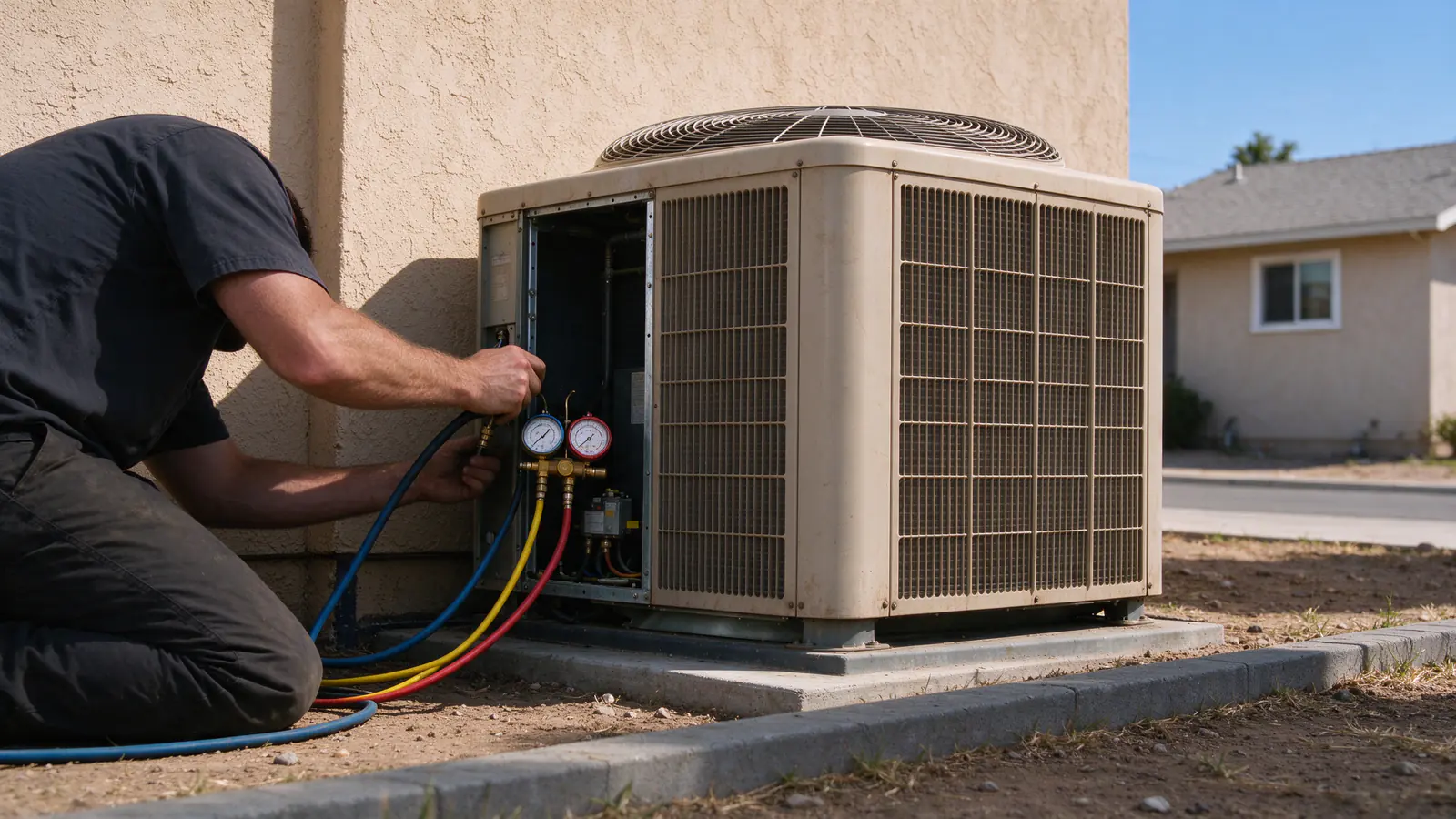
Twelve-plus summers is a fair point to start asking the question. So Veranda Bakersfield Heat Pumps diagnoses first. Our heat pump repair visit starts with what you noticed, then moves through the electrical parts, the refrigerant circuit, the airflow and the controls until we find the cause.
What do we check before giving you an answer?
We look at the failure and the system around it, because a repair only pays off if the rest of the equipment holds up:
- The failed part. What it is, why it failed, and whether something else caused it.
- Refrigerant pressures and temperatures. These show whether the charge is right and whether there is a leak.
- The compressor. Its amp draw and windings tell us how much life it has left.
- The coils. Corrosion, leaks, and how much valley dust has packed into the outdoor fins.
- Airflow. Filter, blower, return air and static pressure, because a choked system wears parts out early.
- The refrigerant type. Older systems may use a refrigerant that costs more to recharge and limits what new parts match.
Then we explain what failed, what the repair costs, and what replacement would involve if it is worth considering.
Which failures are worth repairing?
Some parts fail on every heat pump sooner or later, and replacing them on a sound system makes good sense. Others signal that the system is near the end. This table shows how we weigh them.
| What failed | Repair tends to make sense when | Replacement comes into the picture when |
|---|---|---|
| Capacitor or contactor | Almost always | Only if the system has other major faults |
| Outdoor fan motor | The compressor and coils test well | The system also has a leak or a weak compressor |
| Indoor blower motor | The air handler is in good shape | The air handler is rusted or the coil leaks |
| Refrigerant leak at a fitting or valve | The leak is found and sealed cleanly | The system uses an older refrigerant and leaks keep returning |
| Coil leak | The system is young and the coil part is available | The system has twelve-plus summers on it |
| Compressor | The system is young and everything else tests well | The system is older or the coil is also failing |
| Reversing valve | The rest of the system is sound | The repair needs a full recovery and recharge on an older unit |
What if the repair is fine but the house still runs hot?
Then the cause is likely outside the equipment. A new part brings the system back to where it was, so a house that never cooled evenly still won’t, after a repair or a replacement, until someone fixes the cause.
These all limit what any heat pump can deliver:
- A crushed supply run.
- A single small return.
- Leaky ducts in a hot attic.
We check airflow at the repair visit and tell you if the ducts are part of the story. Our guide on ductwork and airflow explains what we measure and why, and our common problems guide lists the safe checks you can make before you call.
When does replacement start to make more sense?
Replacement moves to the front when two or more of these are true at once:
- The compressor or a coil has failed.
- The system has twelve-plus Bakersfield summers on it.
- It uses an older refrigerant that is costly to recharge.
- Repairs keep coming back on different parts.
- The house has never cooled well, and the equipment was sized wrong for it.
- The indoor and outdoor units no longer match after an earlier part swap.
If you replace, the new outdoor unit and the indoor air handler or coil need to be a matched pair. Putting a new outdoor unit on a tired indoor coil can cost you capacity and leave the old coil as the next failure. Our matching guide explains why.
What does replacement cost compared with the repair?
We price the repair at the visit. For replacement, Veranda’s typical range for a like-for-like ducted heat pump replacement is $6,500 to $15,500.
Where your house lands in that range depends on the size, the equipment you choose, duct work, electrical work and access, all confirmed at the site visit and set out in the written estimate.
The replacement cost guide shows what moves the price in both directions.
How can you weigh it yourself?
Put the repair price next to three questions:
How much life does the rest of the system have?
If the compressor and coils test well, a repair buys real time. If they are worn, the repair may only carry you to the next failure.
What will next summer look like?
A system that limps through September may not survive a 105-degree week in July. Think about when a second failure would hurt most.
Does the house cool the way you want?
If not, a replacement with duct fixes solves a problem a repair cannot touch.
You can also run the numbers in our repair or replace tool. If you decide to replace, the planning checklist helps you get ready for the estimate visit. When the system is down right now, call (661) 269-7726 or see emergency heat pump repair. We tell you on the phone when we can get there and what to do in the meantime.