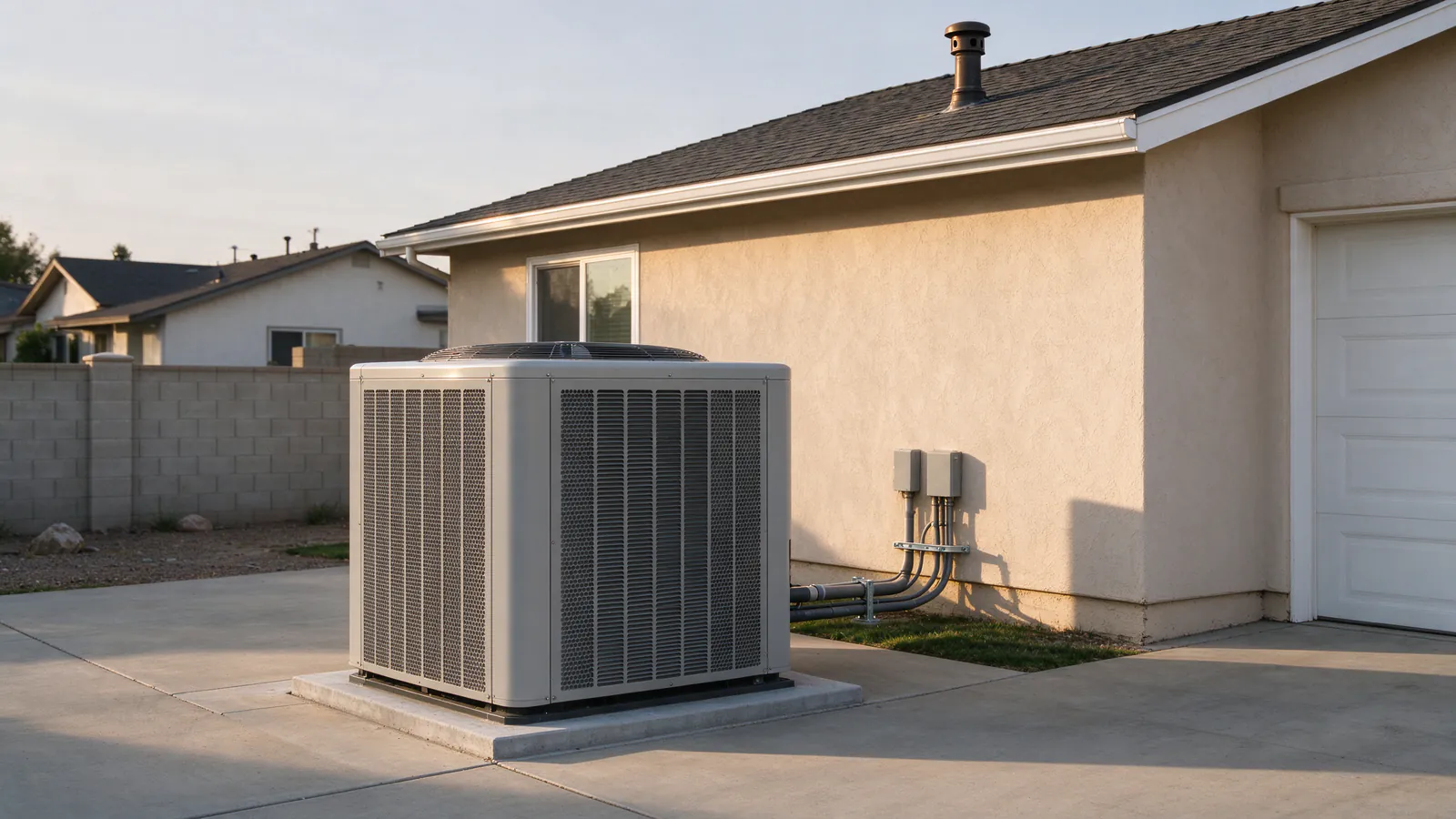
What does each system actually do?
Central air and gas heat means two machines: a condenser outside that cools, and a gas furnace in a closet, garage or attic that heats. They share a blower and ducts, but run on different fuels and wear out on different schedules.
A heat pump, the system Veranda Bakersfield Heat Pumps installs, does both jobs with one refrigerant system. In summer it pulls heat out of the house and dumps it outside, exactly like your AC. In winter a reversing valve flips the flow, and the same outdoor unit pulls heat from the outside air and brings it in.
| Heat pump | Central AC plus gas furnace | |
|---|---|---|
| Cooling | Outdoor unit and indoor coil | Outdoor unit and indoor coil |
| Heating | Same outdoor unit, running in reverse | Gas burner in the furnace |
| Indoor equipment | Air handler, often with backup heat strips | Furnace with a coil on top |
| Fuel | Electricity only | Electricity for cooling, gas for heat |
| Outdoor equipment | One unit | One unit |
Indoors, an air handler with a blower and coil takes the furnace’s place. If you are weighing a new system, our heat pump installation page shows how we scope one from the first visit.
Will a heat pump keep up on a 105-degree afternoon?
Yes, if it is the right size. In cooling mode a heat pump does the same thing as an AC of the same capacity, so it cools the same way.
What decides comfort in a Bakersfield July is sizing, duct condition and where the outdoor unit sits, and those matter just as much for a straight AC.
What happens on a cold January morning in the valley?
It runs longer and now and then defrosts. Bakersfield winters are mild, with cold valley mornings and the odd tule fog week, which is easy work for a heat pump. During defrost you may see a little steam rise from the unit. That is normal.
Heat pump air handlers often carry electric heat strips as backup. They warm the air during defrost and help on the rare morning when the heat pump alone falls behind.
- What can go wrong: a poorly set thermostat can run the strips far more than needed.
- What we do: set the strips up at startup and show you what the display means. Our auxiliary heat and thermostat controls guide explains the settings.
What changes in the house if I switch?
Swapping a furnace and AC for a heat pump touches three things beyond the equipment itself. We check each one at the visit, and each one shows up as its own line on the written estimate.
The indoor unit and where it lives
The furnace comes out and an air handler goes in, usually in the same closet, garage corner or attic platform. We measure the space, the return opening and the condensate route before we choose a model.
The electrical panel
An air handler with heat strips needs its own 240-volt circuit, and the outdoor unit needs one too. We look at the panel’s open spaces and its service size. Our electrical requirements guide covers what we look for.
The gas line
If the furnace was the only gas appliance on that branch, we cap the line at the right point. If you keep a gas water heater or range, those stay on and nothing changes for them.
Which one costs less to run?
There is no honest single answer for every house, because the result depends on inputs that change from one address to the next:
- Your electric rate plan and how much of your usage falls in peak hours.
- Your gas rate and the fixed service charge you keep paying if other appliances stay on gas.
- The efficiency rating of the equipment you are comparing.
- How much heating your house actually needs, which in Bakersfield is modest next to cooling.
- Duct leakage and insulation, which raise both bills.
Because cooling is the same either way, the comparison comes down to winter heating and to whether you can drop gas altogether. Our running cost guide explains how to set the inputs side by side, and the operating cost comparison tool lets you try your own numbers.
Is there a middle path with gas backup?
Yes. A dual-fuel system pairs a heat pump with a gas furnace. The heat pump handles cooling and most heating, and the furnace takes over on the coldest mornings or when gas is cheaper to burn.
It keeps the furnace, the gas line and the furnace’s upkeep in the picture. If your furnace is young and you want to keep it, ask us whether it fits your house. The dual-fuel guide explains how the controls split the work.
What does it cost to put in?
Veranda’s typical range for a furnace-and-AC conversion is $8,000 to $15,500. If you already have a heat pump and are replacing it, Veranda’s typical range for a like-for-like ducted heat pump replacement is $6,500 to $15,500.
Both ranges are tied to the site visit and the written estimate, where we price your house, not an average. If your furnace and AC are both near the end, our furnace to heat pump conversion handles it as a single project.
| Recent conversion | Detail |
|---|---|
| House | 1,300 sq ft 1950s house in Oildale |
| Indoor unit | Air handler in the hall closet where the furnace stood |
| Electrical | New 240-volt circuit on a panel that had room |
| Gas | Line capped |
| Price and time | $12,400, two days on site |
Duct repairs, a panel upgrade or a second return move the number up. The conversion guide covers each of those in detail.
How do we help you decide?
We start with the house you have. At the visit we check the furnace and AC, measure the ducts and return air, open the panel, trace the gas line and note every gas appliance. Then we run the load calculation.
The written estimate lists model numbers, size and why we chose it, duct and electrical work, the permit, removal and disposal, and the startup checks. Where both paths make sense for your house, we can price them side by side so you are comparing your own numbers. You can also request an estimate online or call (661) 269-7726.