Where does the work actually happen?
Most of a conversion happens indoors. The outdoor swap takes a few hours; the closet, the panel and the attic decide how the job goes and where the price moves.
At Veranda Bakersfield Heat Pumps, a typical furnace to heat pump conversion looks like this Oildale job: a 1950s house of 1,300 sq ft with a gas furnace in the hall closet and an AC condenser in the side yard.
- The condenser came out and a heat pump went onto the pad.
- The furnace came out of the closet and an air handler went in.
- A new 240-volt circuit ran from the panel, which had room.
- The gas line to the furnace was capped.
- It came to $12,400 and two days on site.
What replaces the furnace?
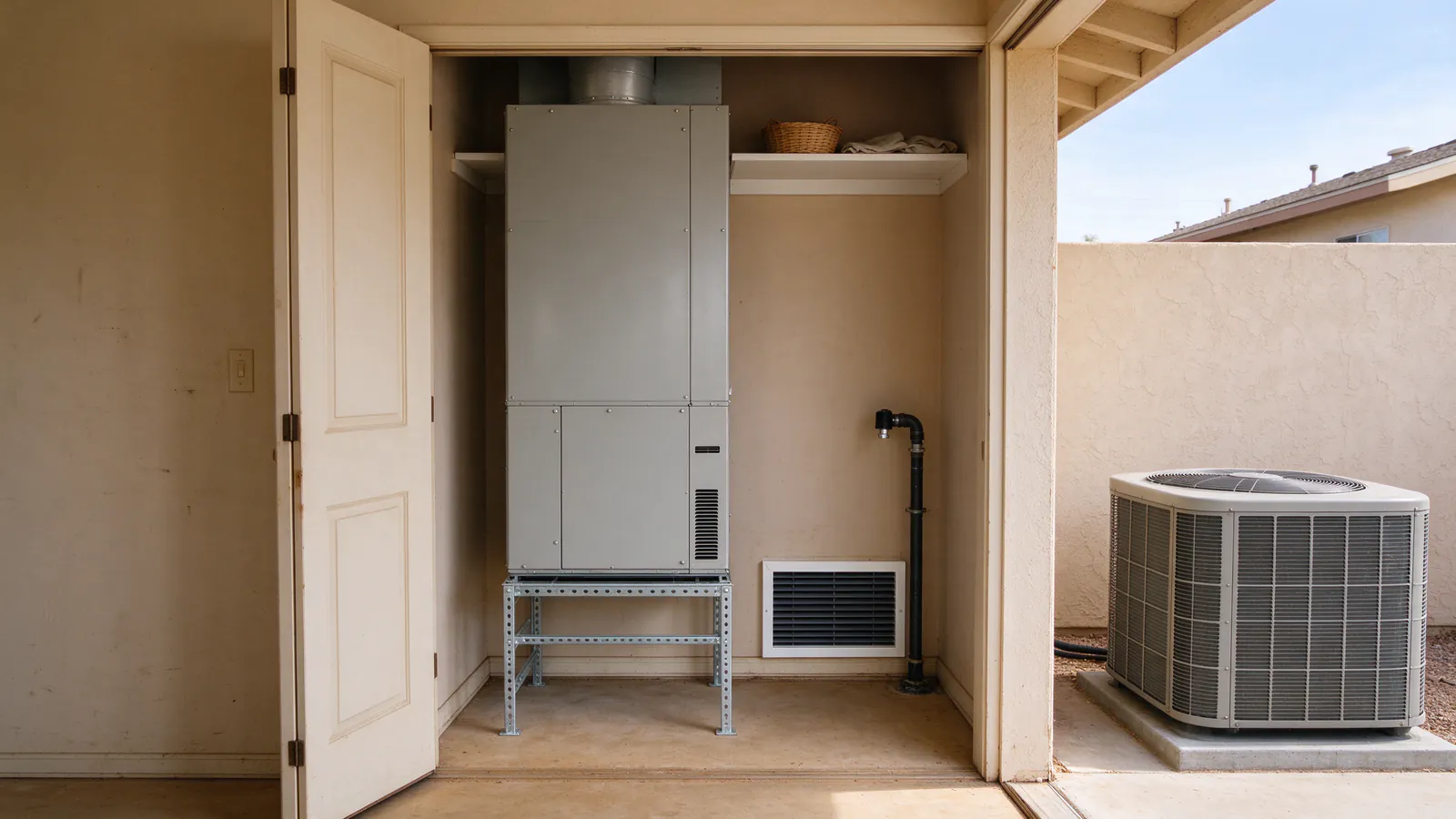
A heat pump needs an indoor unit with a blower and a refrigerant coil. In a conversion that is almost always an air handler: a cabinet holding the blower, the coil, a filter rack and usually electric heat strips for backup.
Will it fit in the same spot?
Often, yes. Air handlers come in upflow, downflow and horizontal versions, so one can usually be found for a closet, a garage corner or an attic platform. We measure:
- The space, including the clearance needed to open the panels later.
- The return opening and the filter location.
- The condensate route, because a heat pump makes water in cooling mode just like an AC, and that water needs a drain or a pump.
- The supply plenum and how it connects to the duct trunk.
Do the indoor and outdoor units need to match?
Yes. The air handler and the outdoor unit are chosen as a matched pair so the capacity and efficiency on the label are what you actually get. Our matching guide covers this in more depth.
What changes at the electrical panel?
A gas furnace draws little electricity, so most furnace closets have only a small 120-volt circuit. An air handler with heat strips needs a dedicated 240-volt circuit sized for the strips, and the outdoor unit’s circuit may need resizing for the new equipment.
At the visit we open the panel, count the open spaces and look at the service size. If the panel has room, the new circuit is a straightforward line on the estimate. If it does not, we tell you what the options are before the estimate is final. Our electrical requirements guide walks through each check.
What happens to the gas?
We shut off and cap the branch that fed the furnace, then check for leaks. The flue that vented the furnace is no longer needed, and we seal or remove it as the estimate describes.
If the furnace was your only gas appliance, the conversion can let you close the gas account entirely. If you keep a gas water heater, range or dryer, the account stays, along with its monthly service charge. That matters when you compare running costs, and our comparison guide lays out the inputs.
Are my ducts ready for a heat pump?
Ducts that served a furnace and AC already carry cooling air, so they are usually close to ready. The difference is winter: a heat pump moves more air at a milder temperature than a furnace, and it depends on good airflow in both modes.
We measure static pressure and look at the return. A single small return, a crushed supply run or leaky joints in the attic all choke airflow. Fixing them at conversion time costs less than coming back later. Our ductwork and airflow guide explains what we measure.
What about the thermostat?
A furnace thermostat does not know how to run a reversing valve or backup heat, so most conversions need a heat pump thermostat. Some also need a new wire run if the old cable lacks enough conductors.
We set the backup heat so it supports the heat pump instead of doing its job, and show you what the screen means. The auxiliary heat and controls guide goes deeper.
What does a conversion cost?
Veranda’s typical range for a furnace-and-AC conversion is $8,000 to $15,500. We set your number at the site visit and put it in a written estimate. These are the things that move it:
| What we check | Lower end when | Higher end when |
|---|---|---|
| Equipment size | Smaller house, modest load | Larger house or heavy west exposure |
| Equipment type | Single-stage | Two-stage or variable-speed |
| Air handler location | Same closet, easy fit | New location, platform or tight attic |
| Electrical | Panel has room | New circuits plus panel changes |
| Ducts | Sound and well sized | Crushed runs, leaks or a second return |
| Gas | Simple cap at the furnace | Longer line work or flue changes |
The estimate lists the model numbers, size and why, duct and electrical work, the gas cap, the permit, removal and disposal of the furnace and AC, and the startup checks. Optional upgrades are priced separately.
Do rebates apply to a conversion?
Sometimes. Programs depend on your address, your utility, the equipment and the program’s funding. We tell you what we know applies when we visit, and any program shows on its own line.
We never count a rebate in your price until it is approved. Our incentives guide explains how to check. When you are ready, request a conversion estimate or call (661) 269-7726.