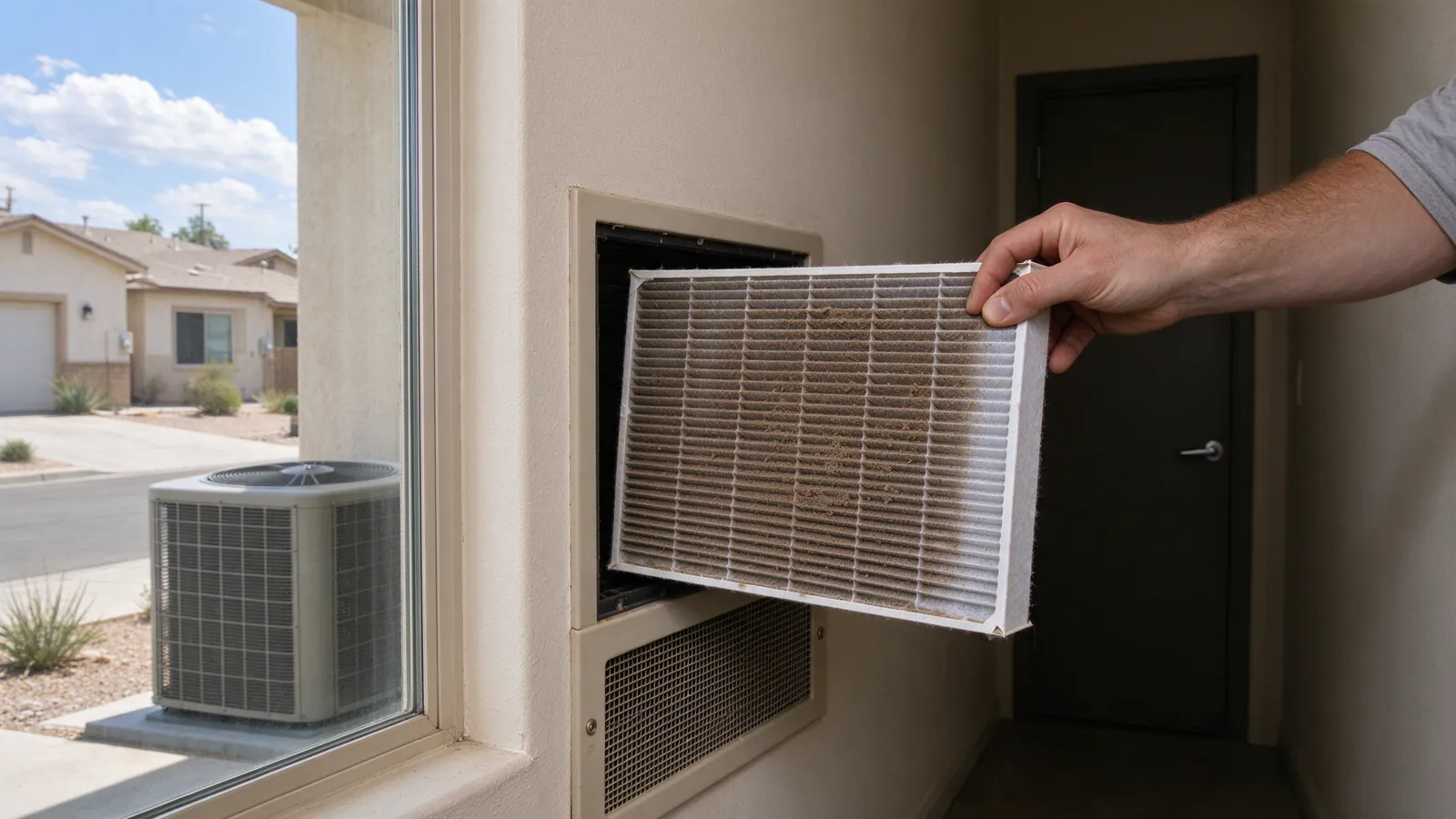
Why does airflow matter so much in a Bakersfield summer?
On a 105-degree afternoon your heat pump moves heat out of the house for hours on end. It can only do that if enough air crosses the indoor coil.
That is why cooling in 100-degree weather depends on airflow as much as on size. Cut the air and the coil gets too cold, the house stops cooling and the compressor works harder for less. Small things cut that air:
- A full filter.
- A closed register.
- A return grille behind a couch.
The good news is that you can check most of these yourself. Here is what to look for, what you can do, and when to call us for heat pump maintenance or a repair visit.
What signs point to a filter or airflow problem?
Weak air, one hot room, a system that runs all afternoon, ice on the lines or water at the air handler. Many of these start at the filter or a blocked return, and the table shows what you can do about each.
| What you notice | Likely cause | What you can do |
|---|---|---|
| Weak air at most registers | Dirty filter, blocked return | Change the filter, clear the grille |
| One room hot, others fine | Closed register, crushed or leaking duct | Open the register, then call us |
| System runs all afternoon and never catches up | Low airflow, dirty outdoor coil, wrong size | Check the filter and outdoor unit, then call us |
| Ice on the copper line or indoor coil | Too little air or low refrigerant | Turn cooling off, run the fan, call us |
| Water around the air handler | Iced coil melting, blocked condensate drain | Turn the system off, call us |
| Whistling return grille | Return too small or filter too restrictive | Try a standard filter, call us |
| Dust on surfaces a day after cleaning | Leaky return duct or loose filter | Check the filter fits snugly |
What can I check myself?
The filter
Find the filter at the return grille in the hall or ceiling, or in the slot at the air handler. Slide it out. If you cannot see light through it, change it, and match the size printed on the frame.
A thicker, higher-rated filter traps more, but it also blocks more air if the return is small. If your return grille starts to whistle after you switch filters, go back to the standard one and mention it at your next visit.
Registers and returns
Walk the house and open every supply register. Closing vents in empty rooms does not save energy on a ducted heat pump; it raises duct pressure and cuts airflow across the coil. Move furniture, rugs and boxes off return grilles.
The outdoor unit
Clear weeds, leaves and grass clippings from around it and keep the space around it open so it can breathe. Look for a dryer vent blowing lint onto the coil, or a fence panel crowding it against a hot west wall. Leave the panels on.
When do I stop and call?
Turn the system off and call us if you see ice, water at the air handler or a breaker that keeps tripping, or you smell burning. Book a diagnostic visit when a new filter does not fix the problem.
Call us for a diagnostic visit if:
- The air stays weak after a new filter.
- One room stays hot no matter what.
- The system runs from noon to sunset and the house keeps climbing.
Those point past the filter to duct leakage, a crushed run in the attic, a dirty indoor coil or a charge problem. Our list of common heat pump problems helps you describe what you see, and our page on humidity and cooling comfort explains why a starved coil also leaves the house feeling clammy.
If the system stops cooling completely in a heat wave, see what to do when a heat pump stops working. Call us. We tell you on the phone when we can get there and what to do in the meantime.
What do we check on a summer airflow visit?
On a maintenance or repair visit we look past the filter:
- Static pressure across the system, which tells us whether the ducts and filter let enough air through.
- Temperature drop across the indoor coil.
- The indoor and outdoor coils for dust, lint and bent fins.
- The condensate drain and pan, which clog more in a long cooling season.
- Return air size against the size of the system.
- Visible ducts in the attic for crushed or disconnected runs.
Nothing gets replaced before we tell you the cost. After the visit you get a written note of what we saw and what we recommend. Our maintenance checklist shows what a routine visit covers through the year.
When is it the ducts, not the filter?
When the return is too small for the system, no filter fixes it. We add return air or repair the ducts so the system gets the air it needs.
In Shafter we replaced the heat pump in a 2,100 sq ft single-story house, kept the same 4-ton size and added a second return. That job came to $14,200 and two days on site. Our guide to ductwork and airflow explains how we find the cause.